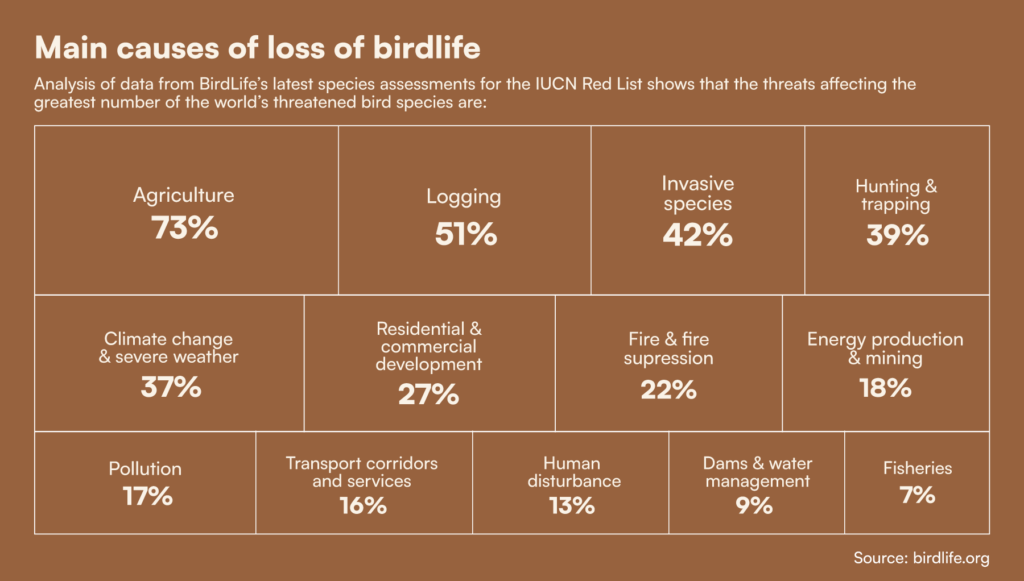
At a glance Bird populations are collapsing—and the food system is part of the problem. Here’s what you’ll learn: Why farmland birds are disappearing across EuropeHow regenerative farmers are restoring habitatsWhat you can do—from your kitchen to your garden A silent spring in the making? In conversations around climate change, energy and emissions often dominate the headlines. However, a quieter, equally urgent crisis is unfolding in our skies: Europe’s bird populations are vanishing. According to a 2021 study published in Ecology and Evolution, Europe has lost nearly 600 million birds since 1980, with more recent estimates putting the number closer to 800 million across the continent. In the latest episode of What the Field, Ariel Brunner, Regional Director of BirdLife International, calls this decline a “planetary red flag.” Birds are not just charismatic symbols of nature—they are key indicators of ecosystem health, and their disappearance reveals systemic dysfunction in the landscapes that produce our food. “We are losing nature at a speed the planet hasn’t seen in 65 million years.” – Ariel Brunner The canary in the cornfield While some species like pigeons or crows adapt well to urban sprawl, farmland birds—once common sights in Europe’s rural areas—are experiencing the steepest decline. The European Bird Census Council reports that 50–60% of farmland birds have disappeared in just a few decades. Species like the skylark (Alauda arvensis) and the grey partridge (Perdix perdix) are now on the brink in many regions. A big reason for this is modern industrial agriculture. Ariel lays it out: monocultures, widespread pesticide use, nitrogen overload, the removal of hedgerows, and the sterilisation of soil have turned vibrant ecosystems into what he calls “green deserts”: fields that are visually lush, but ecologically barren. “If you grow one crop on very big surfaces, you create a very simplified habitat that doesn’t give anything to most of the species. In essence, you should think about it like this: we get from the sun one photosynthetic cake, and the whole biosphere eats from that cake. We are in a situation in Europe today where we humans take between 75 and over 90% of that cake, and it’s like in a party, if one boy comes in and eats the whole cake, all the other boys and girls get nothing. And this is from a purely kind of thermodynamic point of view, what we are doing today.” – Ariel Brunner Locked-in systems, locked-out change A central challenge, Brunner says, is that most farmers and consumers are locked into the current industrial system. Farmers face pressure and debt that ties them to the status quo. Their only advisors are often agrochemical sales reps. Meanwhile, consumers aren’t always sure how to make the right choice for their wallet, their health, and their environment. And behind this locked-in system lies enormous political power. “The intensive farm lobby is one of the most powerful in the world. It has effectively captured the political system in Europe.” – Brunner BirdLife’s mission isn’t just to protect birds—it’s to unlock this system. From local pilot farms to EU policy reform, their work spans scientific research, on-the-ground partnerships, and advocacy. Regenerative Farming: bringing birds back Bird-friendly farming doesn’t require every farmer to be a birdwatcher. But it does require a shift in mindset—from maximising yield at all costs to designing resilient, shared ecosystems. Regenerative-organic agriculture not only avoids the harm caused by industrial practices—it actively restores ecological balance. Here’s how regenerative farmers are making their land bird-friendly again: Planting cover crops: keeps soil alive year-round, boosts insect populations (essential bird food), and reduces erosion.Hedgerows and field margins: Provide nesting sites and shelter for ground-nesting birds, and serve as corridors for safe movement and feeding.Agroforestry and tree planting: Trees offer perching, nesting, and feeding sites while creating vertical habitat layers that mimic natural ecosystems.No-Till or reduced-tillage: Preserves the homes of ground-nesting species and supports healthy insect and worm populations.Eliminating synthetic pesticides: Prevents insect population collapse, crucial for many bird diets, and reduces secondary poisoning of predatory birds.Nest boxes and wildlife structures: Compensate for habitat loss by offering homes to species like barn owls, swallows, and kestrels. These aren’t marginal tactics—they’re proven tools. A study from the British Ecological Society found that diversified farming systems support significantly higher biodiversity, including bird populations, than simplified monocultures. Supporting Birdlife from the Roots: Our farmers take a stand Among the regenerative producers CrowdFarming collaborates with, several olive oil farmers have taken concrete steps to support bird conservation. In 2024, a group of these producers signed the Manifesto for the Protection of Migratory Birds, committing to farm practices that safeguard critical winter habitats for birds in Mediterranean olive groves. One of the most impactful changes they’ve made is the ban on mechanical night-time harvesting (between 20:00 and 06:00), a practice known to cause mass bird deaths during the colder months, when birds use the olive trees as shelter. This commitment, along with measures like maintaining ground cover, installing perches, and preserving natural hedgerows, forms a proactive approach to integrating birdlife protection into farm operations. Today, you can find these producers under the “Environmentalist” badge on the CrowdFarming website. Olivares Vivos Another example is Olivares Vivos, a pioneering conservation project based in southern Spain and led by the Spanish branch of BirdLife International, SEO BirdLife. This project works to restore biodiversity in olive groves without compromising farm profitability. By reintroducing native vegetation, preserving soil health, and enhancing natural habitats, the project has transformed olive farms into thriving ecosystems. Over 165 bird species have been recorded in participating groves, alongside increases in pollinators and other wildlife. Backed by scientific monitoring, Olivares Vivos demonstrates that nature-positive farming is not only possible — it’s profitable, scalable, and essential for the future of agriculture. “The olive grove is the most important crop for biodiversity conservation in Europe. It has immense capacity to restore habitats and wildlife, and we’ve only just begun to tap into its environmental potential.” — José Eugenio Gutiérrez, Lead of Olivares Vivos Farming for Conservation: The Case of Riet Vell Another CrowdFarming rice farmer, Juan Carlos Cirera, brings a particularly powerful perspective to this movement. Juan Carlos was the head of SEO/BirdLife (the spanish branch of BirdLife International) in Aragon. He now manages Riet Vell, combining biodiversity conservation with food production, to cultivate high-quality organic rice. Riet Vell is a unique farm project created by SEO/BirdLife in 2001 in the heart of the Ebro Delta, a key wetland ecosystem in Spain. Of its 52 hectares, 42 are dedicated to organic rice cultivation, while the remaining 10 have been restored as a natural wetland that now serves as a vital refuge for aquatic birds like flamingos, herons, gulls, and linnets. The project also offers volunteer programs and environmental education, inviting people to connect with both farming and nature. “A job that integrates agricultural production with environmental conservation is an enormous and particularly attractive challenge, and even more so at a time of ecological crisis in which we find ourselves.” – Juan Carlos Cirera What can you do? You don’t need a farm to help birds thrive — but supporting the right farms is one of the most powerful things you can do. By buying from regenerative-organic producers, and especially those with bird-friendly practices, your food choices help reshape landscapes across Europe. Many of the birds whose habitats we protect in the south of Spain, for example, are the same birds that will later migrate to the north of Europe. You can also stay informed by following organisations like BirdLife International and their local branches, which regularly publish science-based updates, action alerts, and real stories from the field. Once you’ve aligned your plate with the planet, here are more ways to help from home: Grow native plants on your balcony, terrace, or garden to provide shelter and food for local birds. Even a few shrubs make a difference. Install nest boxes for local species like swifts, sparrows, or barn owls — especially in urban areas with few natural cavities.Offer clean water year-round with birdbaths or shallow dishes — essential in urban areas or during summer droughtsPush for more green spaces in cities Join citizen science programs like eBird or Garden Birdwatch. These programs feed vital data into global bird monitoring efforts. Some European cities now have more biodiversity than the surrounding countryside, proof that change is possible anywhere.