

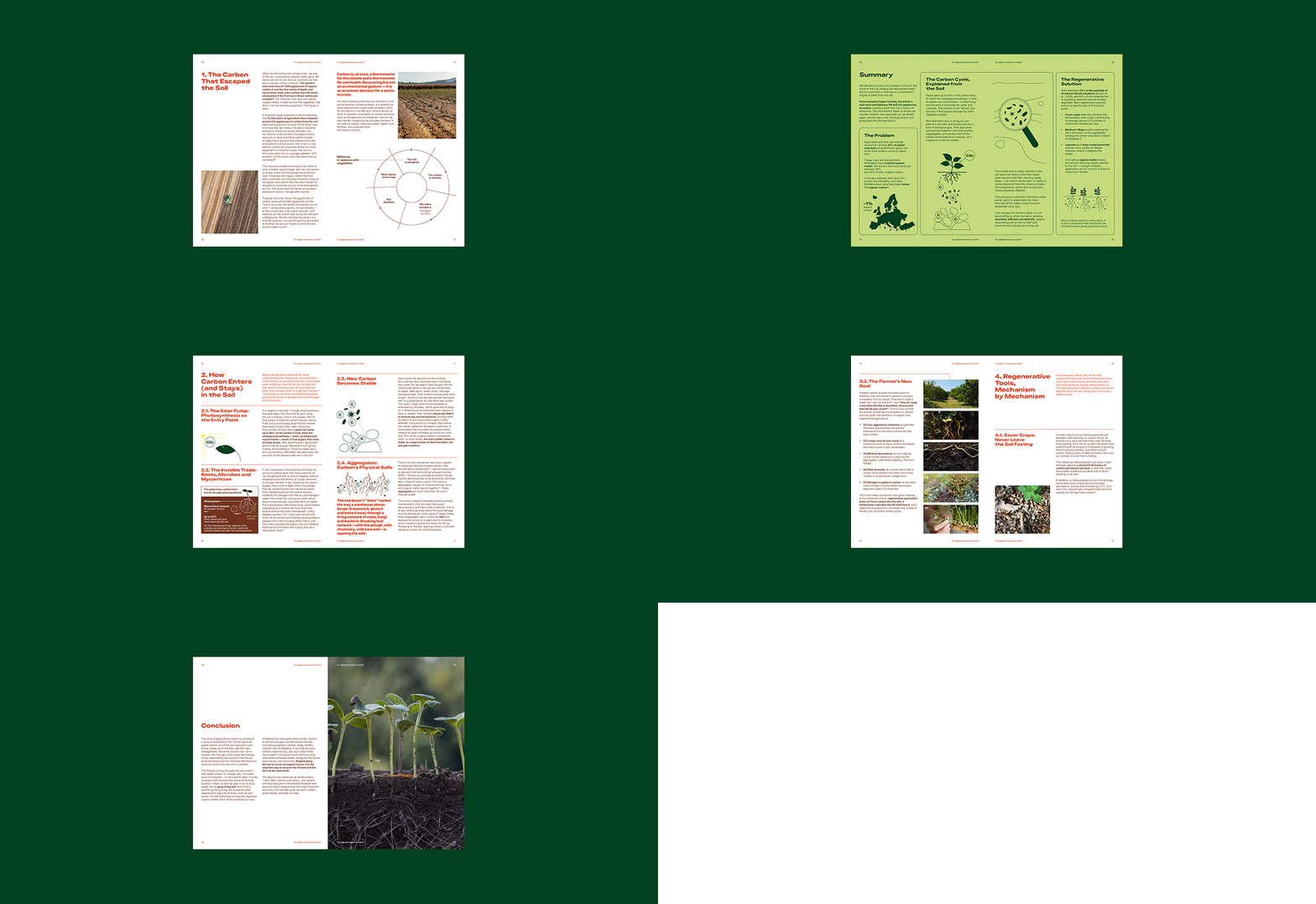
From sink to source. The dominant model turned an ecosystem that captured carbon into a machine that releases it: ploughing aerates the soil, microbes respire the carbon and return it as CO2, the soil gets poorer and becomes dependent on inputs.
Published August 2026
Capturing the sky on earth
We talk about carbon as an air problem. But a big share of the CO2 that’s heating the atmosphere today didn’t come out of a smokestack or a car—it came out of the soil.
When we think about the climate crisis, we look up at the sky: smoke plumes, planes, traffic jams. We rarely look down at the ground. And yet, under our feet there’s a colossal carbon reservoir. The world’s soils contain between two and three times more carbon than the entire atmosphere: around 1,500 gigatonnes of organic carbon in just the first metre of depth. For millennia, that reservoir stayed in balance with the vegetation that fed it. Until we started ploughing it.
The number is brutal. A landmark paper published in PNAS estimates that 12,000 years of agriculture have released from the soil around 133 gigatonnes of carbon[1]. Other estimates put it at around 116 Gt. Either way, that’s more than ten times the industrial emissions of a whole year. Those 133 gigatonnes are equivalent to almost 490 gigatonnes of CO₂**: more than humanity would emit, adding up all sectors, over a good decade at today’s pace. All that carbon was sitting still and safe underground. We brought it up.
It wasn’t a visible catastrophe, but a slow, invisible haemorrhage. The mechanism is simple: every time the soil is flipped with a plough, the organic matter that was protected gets aerated, soil microbes breathe it at full speed, and the carbon that had been stored for decades or centuries returns to the atmosphere as CO₂. The same land that feeds us was being emptied out, harvest after harvest.
116–133 Gt of carbon released from soil by 12,000 years of agriculture.
30–60% of the original carbon lost on average in the world’s agricultural soils.
24% of global emissions come from agriculture and land-use change.
It’s worth stressing that this loss isn’t just some abstract climate problem. It’s the same phenomenon behind declining fertility, greater vulnerability to droughts and torrential rains, and the ever-thinner margins of the European farmer. A soil without carbon holds less water, needs more fertiliser, and produces less nutrient-dense food. In Europe, between 60% and 70% of soils aren’t healthy, and many Mediterranean soils have fallen below 1% organic carbon.
How carbon gets in: the microbial carbon pump
Before we talk about solutions, it helps to understand the mechanism, because it’s the key to everything else. It all starts in the leaf. Through photosynthesis, the plant takes CO2 from the air and turns it into sugars. Some of that carbon is used to grow, but a surprisingly large fraction travels downward: a plant can send up to 40% of the carbon it fixes into the underground pathway, largely as sugars that roots actively exude.
Why would a plant give away almost half its energy? Because it’s not giving it away: it’s investing it. Those exudates are a currency. With them, the plant buys services from the microbes living in the soil, which in return unlock nutrients, fix nitrogen, and move water from places the root would never reach. Mycorrhizae are key: more than 80% of plants partner with these fungi, which weave an underground network far finer and more extensive than the roots themselves.
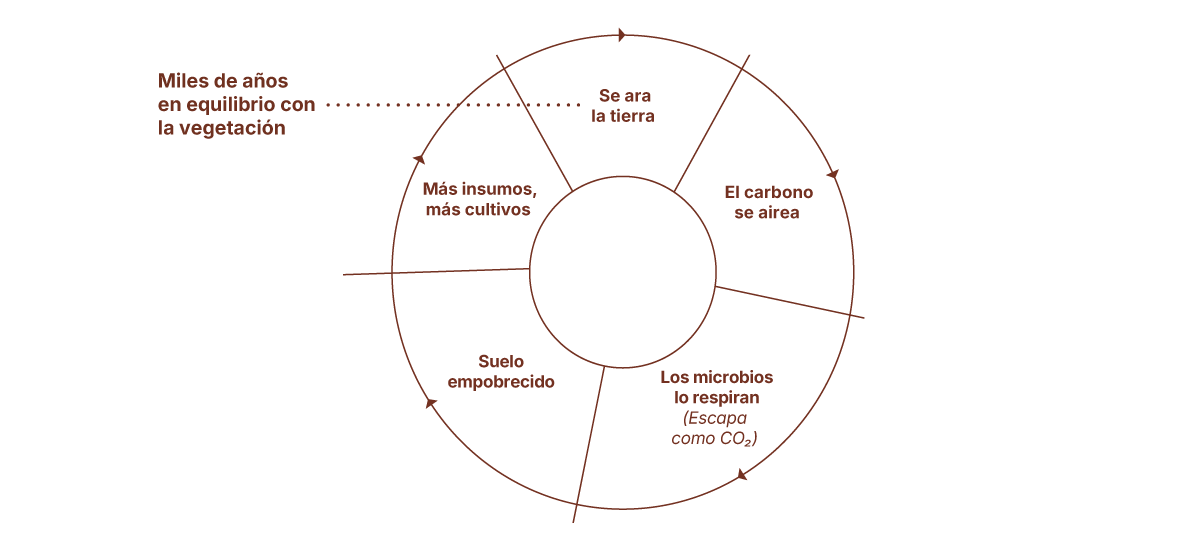
Here’s the counterintuitive fact, and the most important one. For decades, people thought the carbon that lasted in soil was the hardest to digest: lignin, straw, wood. The science of the last decade has shown that, to a large extent, it’s the other way around [4]. The “easy” carbon in sugars is devoured by microbes, which grow and multiply on it. When those microbes die, their remains physically stick to mineral particles of clay and silt. Stuck to a mineral, that carbon can stay stable for decades or centuries. Stable soil carbon is made, to a large extent, of dead microbes, not just plant residues.
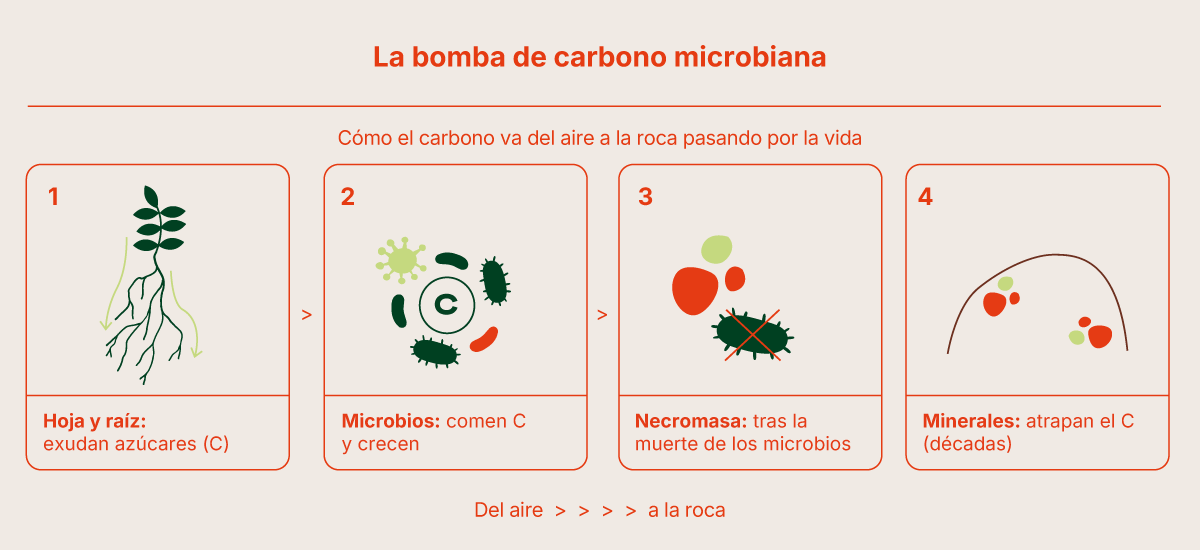
The microbial carbon pump. The plant exudes sugars (1), microbes eat them and grow (2), when they die they leave necromass (3), and those remains get trapped in minerals (4), stable for decades. In many soils, microbial necromass accounts for more than 50% of organic carbon.
POM and MAOM: the checking account and the savings account
Modern science divides soil carbon into two big fractions. POM (particulate organic matter) is still-recognisable plant material: leaves, pruning residues, straw. It’s real and valuable carbon, but it’s labile: it gets spent quickly and is vulnerable to tillage and drought. It’s the soil’s checking account. MAOM (mineral-associated organic matter) is carbon, largely of microbial origin, stuck to clays. It’s stable, persistent, and hard to lose. It’s the long-term savings account.
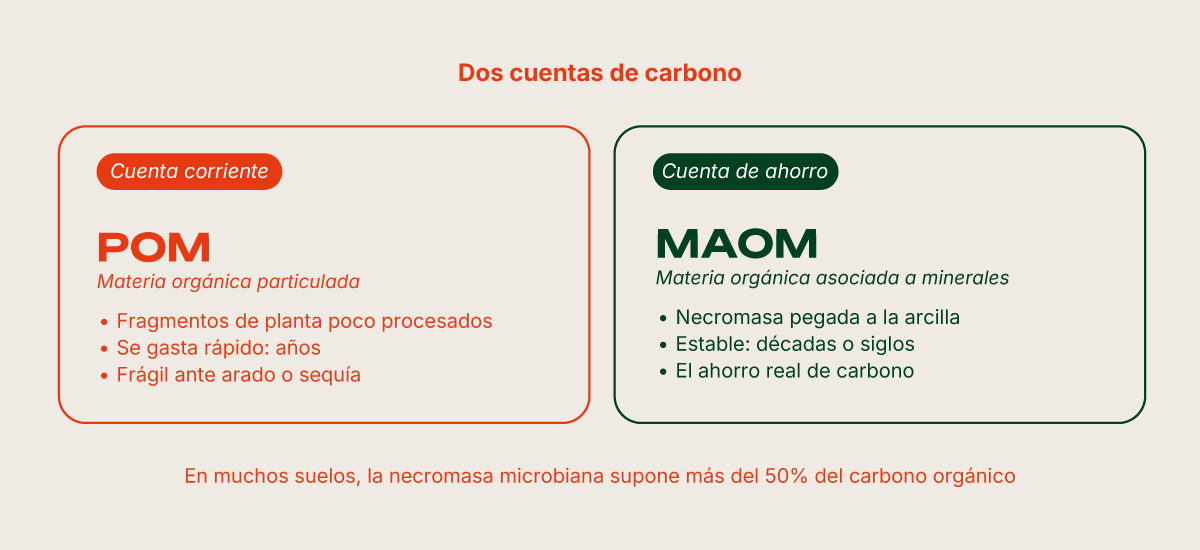
Two carbon accounts. POM is the checking account: lightly processed plant fragments that get spent over years. MAOM is the savings account: necromass stuck to clay, stable for decades or centuries.
This distinction has an uncomfortable but honest implication. Some practices mostly increase POM: they raise carbon in the short term, but in a fragile way. The real solution is to run carbon through the microbes’ “body”. The soil weaves it, sticks it, and locks it away through a living network of roots, fungi, and bacteria that forms aggregates—little clumps that work like a physical safe. Breaking that network with a plough is, literally, opening the safe and letting the carbon escape.
The farmer’s new goal: feed life, not bury carbon
If stable carbon is dead microbes stuck to minerals, the farmer’s question changes completely. It’s no longer “how much organic matter do I add to the soil”, but “how do I keep abundant, diverse, well-fed microbial life all year round”. And it turns out the answer is, almost point by point, the definition of organic and regenerative agriculture: less aggressive chemistry, living roots all year, minimal disturbance, plant diversity, and nitrogen coupled to carbon.
Regenerative agriculture doesn’t force carbon into the soil; it deliberately grows the life that fixes it.
This is the deep connection that makes everything click. Every regenerative practice, looked at up close, is a way of feeding the microbial carbon pump. And each one pulls a different lever in the cycle.
Which mechanism each regenerative practice activates—and what the data says
Practice |
Mechanism it activates |
Reference data point |
|---|---|---|
Cover crops |
Keep photosynthesis and liquid carbon going year-round | ~0.32 t C/ha·year average capture13 |
Minimum tillage |
Protects aggregates; doesn’t open the “safe” | More stable aggregates and organic matter10 |
Legumes |
Provide the coupled nitrogen stable necromass requires | 6–142 kg N/ha replaced; more MAOM |
Deep-rooted perennials |
Move carbon into the subsoil, away from the plough | More carbon at depth; 2–3 m roots (Kernza) |
Compost / organic matter |
Adds carbon and inoculates and feeds microbial life | ~1 t C/ha·year; +40–70% forage15 |
Agroforestry / dehesa |
Adds woody biomass and permanent deep roots | +26–40% organic carbon19 |
The compost case is revealing. In California’s Marin Carbon Project, a single application of one centimetre of compost on grasslands increased forage production by 40% to 70%, and the soil captured on average around one tonne of carbon per hectare per year. A one-off intervention was still capturing carbon a decade later.
The big-picture proof: 78 European farms
What happens when you combine all these levers? The most ambitious field study to date, by EARA and EIT Food (2025), compared 78 regenerative farms across 14 European countries—more than 7,000 hectares between 2020 and 2023—with their conventional neighbours. The results bust the myth that capturing carbon means sacrificing production:
−1% yield in kcal/protein, with 61% less synthetic nitrogen and 76% fewer pesticides22
+25% annual photosynthetic activity, +24% soil cover, +16% plant diversity
+20% gross margin per hectare and 33% higher overall productivity on average
At a continental scale, EARA estimates that European farmers could mitigate around 141 million tonnes of CO2-eq per year in the first years of transition—close to 84% of the EU agricultural sector’s net emissions. Even at the most conservative rate, without stopping producing food, we’re talking about pulling around 92 million tonnes of CO2 out of the air every year.
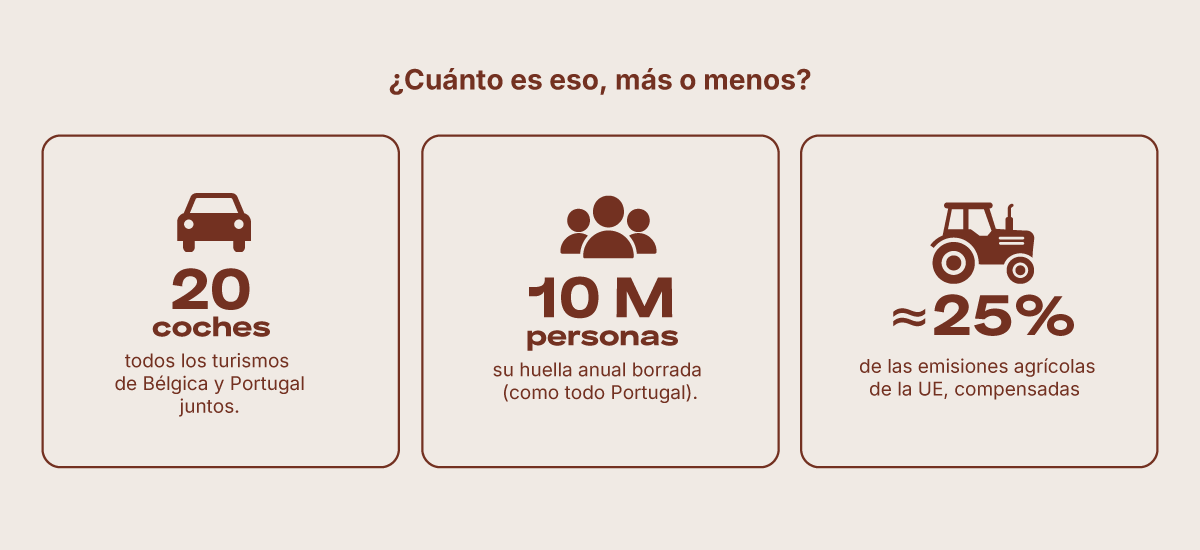
How much is that? Removing 92 million tonnes of CO2 from the air each year is like taking around 20 million cars off the road (all the passenger cars in Belgium and Portugal combined), wiping out the annual footprint of 10 million people, or offsetting close to 25% of the EU’s agricultural emissions. Indicative figures, orders of magnitude.
The necessary caution: limits and honesty
Soil carbon is a powerful solution, but it’s not magic, and three warnings deserve to be written in big letters. The first is saturation: a soil doesn’t accumulate carbon indefinitely. Capture is fast at first, when the soil is depleted and “hungry”, and it slows as it approaches a new equilibrium. The second is permanence: soil carbon is reversible. If a farmer goes back to intensive tillage or an extreme drought hits, some of the captured carbon can return to the atmosphere. That’s why soil capture doesn’t replace cutting fossil emissions: it complements it.
The third is measurement. Measuring soil carbon is expensive and difficult, with uncertainties often in the 15% to 30% range. Without rigorous measurement, reporting, and verification protocols, soil carbon credits lose credibility. The good news is that remote sensing, models, and digital measurement are reducing that uncertainty very fast, and that in December 2024 the EU adopted the first voluntary European framework to certify removals, including carbon farming.
Carbon for soils, not soils for carbon. The goal isn’t to manufacture credits, but to restore living, fertile soils. The climate benefit is the welcome consequence of doing the first thing right.
From environmental cost to strategic infrastructure
The story of agricultural carbon is, at its core, a story of reversibility. For 12,000 years we pulled carbon out of the soil and sent it into the air; today we know that, with the right management, the same process can run in the opposite direction. Not with some exotic technology, but by reactivating two free, ancient forces: photosynthesis and the microbial life that turns carbon from the air into the cement of the soil.
If we treated soil the way we treat a motorway or an electricity grid, maintaining its carbon would be an investment, not a cost. That shift in perspective has a practical consequence for people working the land: the regenerative transition delivers results, but it takes time and an upfront investment most farmers can’t absorb on their own. The better regenerative results are measured and communicated, the easier it will be for the market to recognise them and pay for them.
References
- Cotrufo, M. F. et al. — Microbial carbon pump (MCP) model and MAOM formation.
- Lehmann, J. et al. — Persistence of soil organic carbon: myths and realities.
- Marin Carbon Project — Effect of a compost application on soil carbon and forage production in California grasslands.
- European multi-farm project — Comparison of soil organic carbon in 78 regenerative and conventional farms in eight countries.
- Six, J. et al. — Physical and chemical stabilisation of soil organic matter in aggregates.
- Kallenbach, C. M. et al. — Direct microbial contribution to stable soil organic matter.
- Paustian, K. et al. — Managing soil carbon for climate mitigation: potential and limitations.
Written by Fran Aparicio

Fran Aparicio coordinates Regenerative Agriculture at CrowdFarming, which mostly means he spends his days trying to make farmers, scientists and data people agree on what “healthy soil” actually means. He lives somewhere between muddy boots and research papers, translating field reality into something you can measure (and hopefully improve).
Comments
Keep digging ...