





Published August 2026
Toxic food, the invisible exposure
385 million cases of acute pesticide poisoning every year. Neurotoxic residues in 100% of urine samples tested in healthy Spanish adults. A pear with 14 pesticides in it — all perfectly legal. The history of industrial agriculture is a history of poisons we defended until we couldn’t anymore. So here is the only question that matters: what are we defending right now that our children will pay for later?
Read now
What’s in your food that nobody warned you about
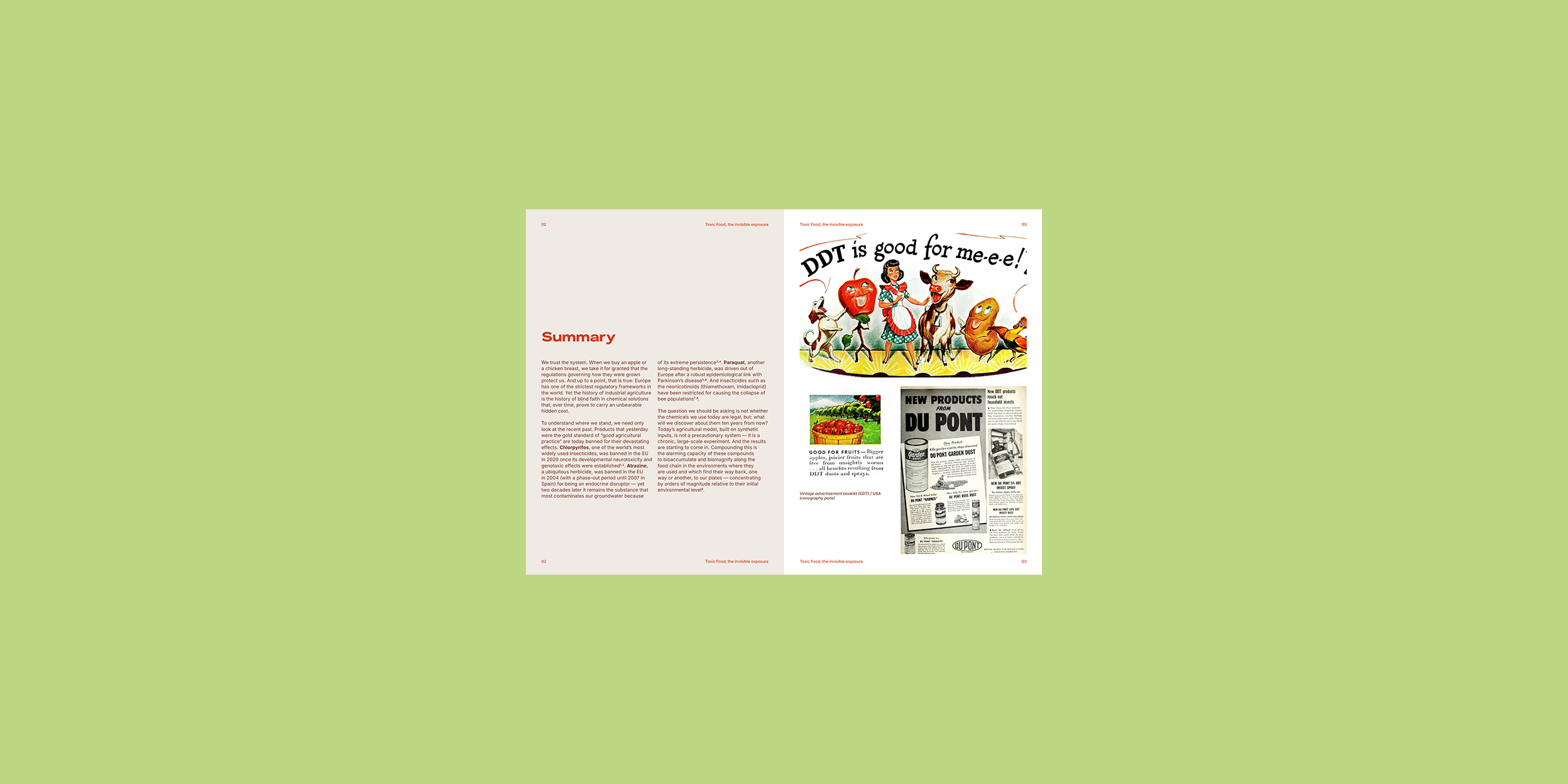
When we buy an apple or a chicken breast, we assume that the rules governing how they were grown are protecting us. And up to a point, that’s true, Europe has one of the strictest regulatory frameworks in the world.
But Europe also banned chlorpyrifos in 2020. One of the most widely used insecticides on the planet, applied for decades, finally prohibited once its developmental neurotoxicity in children was established beyond doubt. It banned atrazine in 2004, an herbicide so persistent it still ranks as the substance most contaminating European groundwater, twenty years later. It restricted neonicotinoids once they were linked to the collapse of bee populations.
The question that keeps coming back to us, and that sits at the heart of our new research paper Toxic Food: The Invisible Exposure, is a simple one: what will we discover about the chemicals we’re currently using ten years from now?
Because what we’re running, right now, is not a precautionary system. It’s a large-scale chronic experiment. And the results are starting to come in.
What the data shows
In 2023, 28% of European food samples contained pesticide residues within legal limits. About one in four contained multiple residues at once. A single pear sample was found to carry up to 14 different pesticides simultaneously, combining suspected carcinogens with endocrine disruptors. Biomonitoring studies across Europe find that 84% of people (children included) carry at least two detectable pesticides in their bodies right now.
Regulators assess the toxicity of each chemical in isolation but that is not how we eat them.
There are also endocrine disruptors to consider, agrochemicals that don’t need large doses to interfere with the body. They mimic hormones, and can disrupt development at minute concentrations. The vulnerability windows that concern researchers most are pregnancy and early childhood. And one of the study’s more unsettling findings is that some of these effects appear to be inherited: animal research shows that epigenetic alterations caused by pesticides like atrazine can be transmitted across three generations, to great-grandchildren who were never directly exposed.
Five days of organic food. That’s all it took.
A study gave primary school children a 100% organic diet for five consecutive days. Within that window, the urinary metabolites of two neurotoxic insecticides, malathion and chlorpyrifos, dropped to undetectable levels. Zero. They stayed there until the children returned to their normal diet, at which point the toxins reappeared.
Diet is the primary route of childhood exposure. That finding also points to something more hopeful: the body responds quickly when you remove the source.
The workers nobody’s talking about
Behind every food item, there are people. And agricultural workers face a level of exposure that bears no comparison to what ends up on our plates. Worldwide, an estimated 385 million cases of acute pesticide poisoning are recorded every year. Epidemiological research now puts the risk of Parkinson’s disease at 70% higher in exposed individuals. The risk of non-Hodgkin lymphoma rises by 41%. In France, Parkinson’s was officially recognised as an occupational disease for farmers in 2012.
Workers don’t just breathe and ingest residues, they handle undiluted product, and the body absorbs it unevenly. The genital area absorbs pesticides nearly twelve times faster than the forearm. Workers carry these residues home on their clothes, and expose their families without knowing it.
Where we go from here
The paper doesn’t end with a list of things to feel bad about. It ends with something more pragmatic: the agricultural transition that removes these inputs from the system already exists, already works at scale, and is being practised by farmers across Europe right now.
What’s also worth knowing is that an organic diet, even for 24 to 48 hours, has been shown to produce a measurable drop in the excretion of toxic metabolites from the human body.
Read now
Written by Fran Aparicio

Fran Aparicio coordinates Regenerative Agriculture at CrowdFarming, which mostly means he spends his days trying to make farmers, scientists and data people agree on what “healthy soil” actually means. He lives somewhere between muddy boots and research papers, translating field reality into something you can measure (and hopefully improve).
Comments
Keep digging ...


by christopher hart on May 2026
These papers you are producing are just brilliant. Some of the best, clearest information I’ve come across. Keep up the good work!
by Emilia Aguirre on May 2026
Thank you so much for your support Christopher, these are the kind comments that make us want to keep going!
by Liliane Senepart on June 2026
Many thanks and great respect for your excellent work! It’s good to know that all over the globe, we must keep on trying and fighting for a healthier world!