
Looking for more? 

We’re just an email away.

Regenerative Agriculture

min

Published January 2026

A Recap of our Regenerative Farming Workshops with Climate Farmers

This summer, CrowdFarming hosted two regenerative agriculture workshops in Spain (Valencia & Malaga) to bring farmers together to learn and discuss regenerative agriculture practices and, hopefully, to kick off our path together on discovering what this way of farming has to offer both farmers and consumers.

First and foremost, it is important to remember that regenerative agriculture remains a relatively new concept for many and that it hasn’t been officially defined yet. However, we believe it has a very promising future in creating a more sustainable and fair supply chain – CrowdFarming’s reason to exist – but also a healthier and more resilient one. 


During the workshops, we discussed only some key elements of regenerative agriculture and tried to focus on the areas and crops representing the farmers participating – regenerative farming is not only results-oriented but highly context-dependent. We discussed soil health, plant health, water management, profitability, nutrition, and livestock integration. Of course, there is an array of different aspects of regenerative agriculture and many practices, all aligned with one purpose: regenerating the land that feeds us. 

It is key to highlight that these workshops are not the end goal. On the contrary, they intend to be a space for farmers to learn more about the science behind regenerative practices, to share amongst each other their challenges and how regenerating can contribute to their farm’s business and ecosystem. These two farmer meetings were meant to plant the seed of changing the way we approach agriculture from a plant-product vision to a much more holistic approach with soil as the main character. 

Valencia area: Back to the roots in Naranjas del Carmen, the founders’ orange farm.

Our first workshop was set on our founders’ family farm “Naranjas del Carmen”. An ideal space for this first event, seeing as it is a farm already shifting to regenerative practices. 

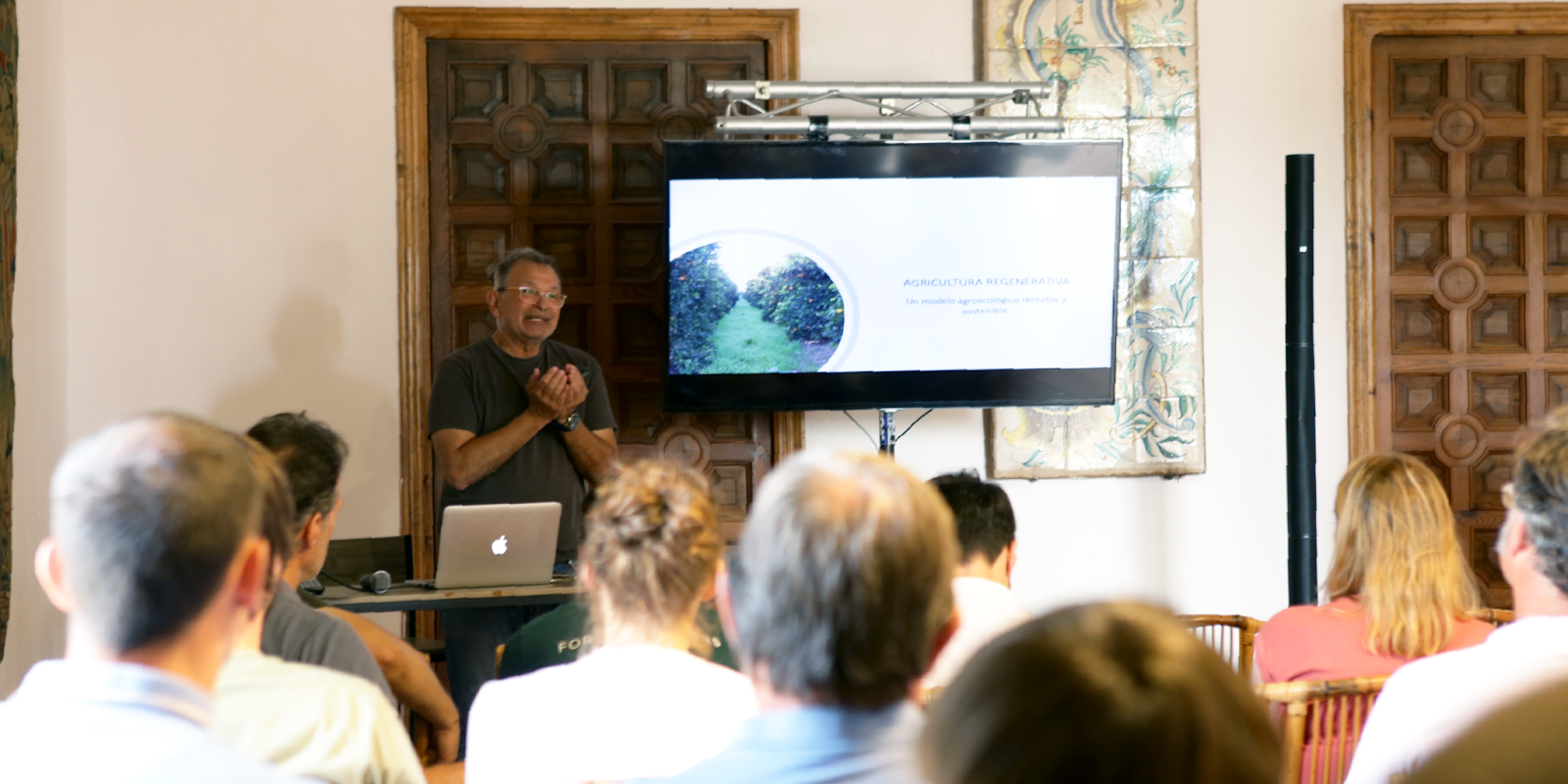
For each workshop, we invited experts in the field to share their knowledge and experience. Our first guest speaker in Valencia was Alberto Peréz Roldán, a scientist and advisor to producers, as well as a soil specialist. He started by highlighting the importance of having a holistic vision of agriculture and understanding that healthy soil is the key to producing healthy crops and healthy food. 


It was interesting to understand that regenerative agriculture does not exclusively mean a return to the “old-fashioned” ways of farming, and that technology is welcomed when put to use in the right way. Soil analysis, for example, is an essential tool recommended to farmers to understand their soil’s composition and therefore what kind of inputs (organic or inorganic) might be beneficial and more importantly how much of it should be used. Being efficient in the inputs farmers use is not only sustainable from an environmental point of view, but from a financial one too.

We learned how to read what was happening in the soil through the signs plants show us,  and we had a hands-on experience of running a soil analysis with our second guest speaker, Manuel Lopez Jerez. We understood that our farms should mimic nature’s diversity to favour healthy crops, which means we need to abandon the misconception that we can sustain our agri-food system on just a few elements such as nitrogen, phosphorus, or potassium.  


Andalusia: The land of the subtropical fruit within Europe’s borders.

Our second workshop in Malaga welcomed mainly citrus, olive and subtropical fruit farmers (mango, papaya, avocado, etc.). Some of these farmers have been facing the tough climate conditions we have witnessed lately, while their products have faced stigmatization, even when farmed responsibly. 

Our guest speakers for this event, Miguel Ángel Gómez Tenorio and Francisco Rodríguez León shared successful case studies of farms in water-pressured areas, either for rain-fed or irrigated crops. They have been working with farmers for years to learn to read what is happening above and below the ground to optimize water flows and water retention. This second workshop also focused more on livestock integration. This concept has many benefits to farming, and, if done properly and sustainably, it has amazing potential to increase soil health, weed control and shift away from industrial animal production.


Here are some of the key topics discussed during the course

1. Soil microbiology


Through soil analysis one can obtain the levels of potassium, sulphur, iron, zinc, calcium, magnesium, phosphate, chlorine and many more. The key to healthy soil is having the right amount of each of these elements to create a balanced and resistant ecosystem. 

For example, Calcium is the first mineral to be corrected in the soil. This is because it directly affects the absorption of the others. In its correct proportion, it allows more clay-based soils to “unlock”, leaving pores open for water and air. It also exerts a flocculation effect on the clay particles and establishes a bridge between minerals and humus. Humus and soil health are inseparable aspects, humus is the manifestation of microbiological activity on organic matter.  A 1% increase in organic matter in the soil represents 170,000 litres of water per hectare of storage. That 1% also represents 132 tons of CO2 captured in the soil. This is also valuable knowledge when calculating carbon sequestration. For example, 1 part of Nitrogen fixes 30 parts of Carbon. And 1 part of Sulphur is necessary to fix 10 parts of Nitrogen. Therefore, 1 part of Sulphur is necessary to fix 300 parts of Carbon.

First learning: Diversity and balance in our soils are key aspects for the correct functioning and optimized growth of our crops.

2. Photosynthesis


Another key point discussed in the workshops was the importance of photosynthesis, the often overlooked source of a healthy crop. Today, a photosynthetic capacity between 15% and 20% is typically seen and accepted as normal. However, at these levels, the plant is unable to develop a proper immune system to cope with pests, diseases and climatic stress, therefore creating a need for inputs such as pesticides, herbicides, or fungicides.

When this capacity is increased to 60%, the plant’s vital development is greatly enhanced. The plant increases its capacity to form structurally complete compounds such as carbohydrates, proteins and plant secondary metabolites (PSM). This generates a fully developed immune system.

Learning: When farming, we have a free energy source – the sun – we are not yet optimizing to its maximum capacity and which could directly impact crop yields. 

3. Nutrition


The nutritional value of the produce is such an important factor for the farmers and the consumers. Through having healthy soil, regenerative practices tend to increase the nutritional value of the yield by supplying more nutrients to the plant. To better understand the impact that chemical inputs and conventional farming have on the nutritional value of our food, here is a simple example:

In 1951, eating two peaches covered the daily need for vitamin A. Today we would need to eat 53 peaches to cover that need (1). This shocking fact helps us understand the urgent need to shift our mindsets as consumers and begin selecting products that benefit us nutritionally. 

Learning: Soil can be seen as the plant’s digestive system. Healthy soil means nutritionally rich plants and products, and, therefore, nutritionally rich consumers!

4. Water 


Water management is one of the most challenging and pressing topics in agriculture in Spain – and many other European areas – due to the increasingly heavy droughts and high temperatures. 

The water shortages have had a huge impact on many farmers, and learning how healthier soil can absorb and retain more water than “dead” or eroding soil is a key part of regenerative farming and ensuring food security for future seasons. (Check out our blog post specifically about the droughts in Europe here). 

Planting cover crops during certain times of the year can protect the top layer of soil so that it is not exposed to the sun, wind and rain, therefore avoiding soil erosion and increasing water retention. 

Learning: Regenerative agriculture integrates water management tools to increase efficiency and crop resistance to droughts.

5. Integrating livestock


Nature is a very well thought system on its own. We know that industrial animal production is a primary source of greenhouse gases globally, however, integrating livestock into mixed farms has many benefits. 

Not only is it a “quick” way to increase topsoil and maintain soil health, but they also provide a readily available supply of organic manure and can be a great help in contributing to weed control and soil decompaction cycles. 

Learning: Livestock integration can be difficult to implement depending on the context of the individual farmer but brings many benefits to soil quality.

This is just the beginning – but the beginning of what?


In CrowdFarming, we have a unique opportunity to make both farmers and consumers care about how our food is produced. With the rise of regenerative agriculture, we believe it is our duty to bring them along on this journey, as it is in the best interests of both. These workshops are the first step of a 3-year program created by CrowdFarming in collaboration with Climate Farmers to lead CrowdFarming producers in this transformation towards regeneration. 

We chose Climate Farmers as our partners in this journey because of our aligned vision of transforming the agri-food system at scale and with farmers at its core. They are doing an amazing job by building communities of farmers, providing them with training and technical support through the best local experts, like Alberto, Manuel, Paco and Miguel Ángel, and looking for ways to finance the transition. They also have a significant role in the definition of regenerative agriculture at a European level and the definition of policies to encourage its implementation. 


After learning all about these different topics, our farmers had some time to reflect on and discuss their particular challenges. It was inspiring to see producers show such interest in each other’s experiences and speak candidly about the difficulties they may face.  Each of them has a vision and a preferred approach, and sharing these through collaborative discussions is extremely beneficial. This is what it is all about, building communities, sharing challenges and finding new ways of facing them in tune with nature. 


Seeing as regenerative farming is still in the early stages of its development, farmers can often feel alone or isolated when trying to tackle climate problems head-on. Having interviewed many of the participants, we asked them about their experience, and we were thrilled to witness  the strong feeling amongst producers that they are creating, together, the bases and the structure of what regenerative farming means.

To conclude, at a time when most of the news and information about agriculture and climate is negative and overwhelming, these workshops bring us hope, showing us that not only farmers are ready and interested in hearing about regenerative practices, but so are organisations and companies like Climate Farmers and CrowdFarming. And, of course, you, our readers and CrowdFarmers, who support CrowdFarming producers on this new path towards a fairer and more sustainable – and now also more nutritious – agri-food industry chain.


1.  McCance R.A.“A study on the mineral depletion of the foods available to us as a nation over the period 1940 to 1991.” Medical Research Council, Ministry of Agriculture Fisheries and Foods, and the Royal Society of Chemistry; Burns, Sarah. “Nutritional Value of Fruits, Veggies Dwindling.” MSNBC. 9 July 2010.

Written by Emilia Aguirre
Emilia Aguirre

Emilia Aguirre est notre spécialiste Sensibilisation & Plaidoyer — ce qui veut dire qu’elle passe ses journées à poser des questions qui dérangent sur la façon dont notre alimentation est cultivée, fixée en prix, étiquetée et vendue. Elle anime What The Field?!, un podcast rempli d’histoires de terrain, de recherches percutantes et de conversations avec celles et ceux qui façonnent l’avenir de l’alimentation (qu’ils le veuillent ou non).

Share this content:

Keep digging ...

Regenerative Agriculture

5 min

Why is growing organic stone fruit so risky?

Understanding the risks of growing stone fruit is key to appreciating why peaches, apricots, and nectarines are so complex to cultivate under an organic and regenerative agricultural model. Their short growing cycle, high sensitivity to weather conditions, and limited post-harvest lifespan create a scenario where precision and timing are critical factors. Why is the stone fruit growing season so short? Most summer stone fruits complete their entire development cycle, from blossom to harvest, in under ten weeks. This rapid evolution drastically reduces the margin for error for the farmer. The window for an optimal harvest is not only brief but also highly variable, depending on the speed of ripening and meteorological events. Increasing climate volatility in Europe adds a layer of unpredictability. A specific example can be found in the region of Catalonia, where organic stone-fruit farmer Jordi Garreta explained how this year’s prolonged spring rains interfered with the fruit set and final ripening, affecting the available harvest volumes. Furthermore, several hailstorms damaged and split some of the fruit. Each variety presents specific vulnerabilities: Cherries are prone to splitting with sudden rains. Apricots are particularly sensitive to thermal stress. Peaches are highly vulnerable to fungal diseases in high-humidity conditions. A regenerative and organic approach to the risks of growing stone fruit Farmer Jordi Garreta, Grup Garreta Farm, Spain In conventional agriculture, the control of pests and diseases often relies on the use of synthetic inputs. The organic and regenerative approach, however, seeks to create a resilient ecosystem, addressing the root cause of pests — an unbalanced ecosystem that allows excessive growth of a specific organism  —  instead of the consequences. As Jordi Garreta explains: “The main pests and diseases are aphids, earwigs (Forficula auricularia), and fungi like Monilia and Rhizopus. The best way to combat them is to have a crop that is well-balanced in its nutrition, meaning that each tree uses its own tools to fight off pests. If this is not enough, we use kaolin, nettle slurry, or diatomaceous earth. We plant flower strips and allow spontaneous wild herbs to grow to encourage biodiversity, which creates a more resilient ecosystem against pests, among other benefits.” Jordi Garreta Farmer at Grup Garreta Scientific research supports these practices. For example, a 2022 study found that tree rows closest to perennial flower strips averaged a 60% increase of predators per branch, compared to those found in control orchards without flower strips. These methods not only addresses pests in the short term, but also prioritises the long-term health of the soil and the ecosystem, which ends up paying back by increasing the ecosystem’s resilience. What are climacteric fruits, and how does it affect their flavour? Most stone fruits (with the exception of cherries) are climacteric, meaning they continue to ripen after being picked, thanks to the internal production of ethylene. While this allows farmers to ship fruit that is still firm, it demands precise timing. Harvesting too early results in flavourless fruit; harvesting too late makes transport difficult, especially in organic farming where many chemical preservatives and treatments are prohibited. Post-harvest losses are one of the biggest challenges facing the food system. According to the FAO, fruits and vegetables suffer the highest loss rates, exceeding 20% ​​globally before even reaching stores. Within this category, delicate and perishable fruits such as stone fruit are particularly vulnerable to mechanical damage and over-ripening, specially given the high temperatures in the season in which they are harvested and shipped. This is where production models diverge significantly: The conventional model: The food industry has adapted to these biological limits through early harvesting, cold storage, and prioritising varieties selected for their durability rather than their organoleptic (smell and flavour) qualities. Supermarkets often pressure producers to deliver uniform, long-lasting products at low prices. This model depends on an intensive cold chain and production surpluses, which typically ends up in high food waste and comes at the expense of flavour and nutritional density. It is estimated that stone-fruit losses from farm to table can range from 20 to 50% globally.  The direct sales model: By harvesting on demand, the fruit is picked at its point of physiological maturity, prolonged cold storage is avoided, and overproduction is reduced. This not only minimises food waste but also preserves the product’s integrity and allows for fairer pricing structures that reflect the high risk and labour intensity required to grow these fruits without synthetic inputs. A practical guide to at-home conservation Once the fruit arrives at your home, its proper handling is essential to enjoy its maximum quality. Ripen at room temperature: If your peaches, nectarines, or apricots are still firm, leave them at room temperature, away from direct sunlight. To know if a peach or apricot is ripe, the key is not always the colour, but the touch and the aroma. You will know they are ready when they yield slightly to a gentle press and give off a fragrant aroma. Refrigerate after ripening: Once ripe, you can move them to the fridge to extend their life for a few more days. Low temperatures (especially below 8 °C) can impair the development of flavour and texture in fruit that has not yet ripened. The case of cherries: As they are non-climacteric, cherries do not ripen after harvesting. They should be refrigerated immediately to maintain their freshness. Wash just before eating: Avoid washing the fruit before storing it, as moisture can accelerate its decay. Wash it just before you intend to eat it. To know more about how to handle your summer fruit, here you have a specific article to guide you through. Towards a resilient model for a vulnerable sector Farmer Anita Minisci, Azienda Agricola San Mauro, Italy The combination of short seasons, high climate sensitivity, and market pressures are the main risks of growing stone fruit, making summer stone fruit production one of the most complicated sectors of organic fruit farming. As climate volatility increases, producers will face greater uncertainty.   Supporting producers through transparent and direct supply chains is not just a consumer preference; it is an essential shift to sustain production models that prioritise soil health, quality nutrition, and long-term resilience.  

Read

Regenerative Agriculture

min

Why is making farmers visible key to scaling Regenerative-Organic agriculture?

What if everyone could name their favourite farmer? We can often name our favourite chefs, dream to visit their restaurants, or buy their cookbooks. But when asked to name a single farmer, many draw a blank. This anonymity isn’t just a symptom of a broken food system—it’s one of its root causes. To scale regenerative-organic agriculture and make it the industry standard, we need more than new practices; we need new role models. This was a key discussion point on our podcast episode with Analisa Winther, co-founder of Top 50 Farmers. The Imperative to Scale Regenerative Farming  Regenerative-organic agriculture encompasses farming principles and practices designed to restore and enhance the farm’s entire ecosystem. It prioritises improving soil health, optimising water cycles, increasing biodiversity, and sequestering carbon, ultimately aiming to produce nutrient-dense food while working in harmony with nature. Currently, such regenerative practices are implemented on approximately 15% of global cropland. According to World Economic Forum, to meet climate goals and ensure food system resilience, this figure ideally needs to increase to 40% by 2030.  The way Winther see’s it, one way to encourage regenerative farming expansion is to bring top farmers to the spotlight.  Launched in 2025, Top 50 Farmers was inspired by how the gastronomy world transformed chefs into celebrities. Now, the focus shifts from the food we eat and its cooking techniques, to what that food eats: the nutrients in the soil, and the regenerative practices that generate it. The first cohort of farmers ranges from 26 to 70 years old, with farms stretching from a half hectare to 4,000 hectares in size. Too often, regenerative agriculture is perceived as young, modern, small-scale: niche. This can alienate the very farmers we need to engage: the ones who have worked the land for decades, often in conventional systems, who are curious and considering change but may be unsure how to begin their transition.  By amplifying stories across generations, scales, and methods, Top 50 Farmers offers a vision of a regenerative movement that is inclusive, grounded and real. Why does visibility matter? Visibility has tangible economic consequences. When farmers become household names, the value of their produce—and the standards behind it—gain weight. Visibility can lead to policy influence, new markets, and stronger community ties. It also breaks the cycle of anonymity that enables disconnection and devaluation within the food system. As Cristina, our Head of Impact and podcast co-host, put it, “When you’re a farmer that is producing for anonymous consumers through big channels like supermarkets, you’re not necessarily held accountable. It’s very unlikely the consumer will ever be able to trace the product back to you.” But with a name, a face, and a story, the relationship changes, there is commitment and accountability from both sides. Consumers commit to paying fair prices, accepting produce that doesn’t come in standard shapes and sizes, and  farmers commit to delivering the best quality and staying true to their word — they can now be held accountable. The result is a deeper trust and understanding, longer relationships (like adoptions), and eventually better food and more sustainable farming practices.  “That’s exactly why models like direct sales, adoption programmes, or agro-tourism matter. They aren’t just marketing tools. They are vehicles for building long-term, reciprocal commitment.” – Analisa Wither Regeneration is a journey, not a destination Although at CrowdFarming we do have our definition of what regenerative agriculture is and how it coexists with the organic certification, there is no consensus across the industry for what makes a farm “regenerative.” There are no red lines, and that’s part of the challenge—and the strength—of the movement. Analisa reminded us that “regenerative is not a destination. It is a mindset, a philosophy, and an approach”. Farmers in the Top 50 are at different points in their journey—some just starting out, others continuing multi-generational practices. What unites them is a willingness to learn, adapt and build with nature. The focus isn’t on perfection, but on direction. The community created allows them to connect, and share their progress. And as we’ve figured out by now, there is no better way to learn about something than to talk about it to somebody who has tried it before you. The path forward: Inspiration and infrastructure Our shared long-term vision is bold but necessary: “Regenerative-organic agriculture will be the industry standard once again”. That will require not only cultural shifts but systemic support. More farmer-focused policies. Better access to knowledge. Tools for financing and cooperation. And visibility. Because the more we see the people who grow our food—not as faceless suppliers but as innovators, entrepreneurs, and role models—the more we understand what’s at stake. Because if the diverse mix of farmers from each cohort gains the confidence to go back to their communities and share what they’ve learned in their journey, that might get the mind shift started for others.  “We’re not trying to crown the ‘best’ farmer. There is no best. What matters is showing the breadth of ways people are already regenerating—on a half-hectare in Lithuania or on 4,000 hectares in France. What matters is shining a spotlight, so others can see themselves in the story.” – Analisa Wither

Read

Regenerative Agriculture

min

What is regenerative agriculture, and how does it coexist with organic certification?

At CrowdFarming you can mainly find organic farmers. Moreover,  ever since we started, we decided to integrate farmers converting to organic as well because, as farmers, we know how difficult the transition process can be.  We stand firm in our position in defence of organic farming. But we also want to be part of a movement that is becoming more and more relevant in Europe and worldwide, namely regenerative agriculture. However, this sometimes creates tensions for us, and many internal debates. In this article, we share with you our views.  Is organic farming not enough? If we refer to the EU Council Regulation of June 2007 on organic production and labelling of organic products (Regulation (EC) No 834/2007), we find objectives very similar to those described today for regenerative agriculture: ‘To ensure a viable system of farm management that respects natural systems and cycles and preserves and improves the health of soil, water, plants and animals and the balance between them, and contributes to achieving a high degree of biodiversity.’ In addition to ‘high-quality products’. However, as a certification was created for a European level, the regulations had to be adapted to a wide variety of contexts. The current regulation of organic farming is mainly based – although it includes other premises – on limiting the use of artificial fertilisers, herbicides and pesticides, which means that organic farmers must adopt different methods to maintain soil fertility and the health of animals and plants, such as the cultivation of nitrogen-fixing plants and other green fertiliser crops to restore soil fertility.  In conclusion, organic farming is, in its essence, very close to regenerative agriculture. Organic certification is based on a list of permitted and prohibited techniques, which undoubtedly play a fundamental role in protecting the environment from the more damaging techniques of the conventional system. However, as the results are not measured in the environment, a certified organic farmer may not be regenerating his ecosystem.  Is there a certification for regenerative agriculture? There is no unified definition of regenerative agriculture. Nor is there a certification at a European level. Which means, there are thousands of them. Today, anyone can claim to be regenerative, and this leaves the door wide open to cunning and slippery greenwashing techniques. It’s a danger to those who are doing it right, and it’s a danger to consumer trust.  At CrowdFarming we believe that a new regenerative certification would lead to exactly the same results as where we are today with the organic certification. After the titanic effort that has been made to push organic farming, which today accounts for only 9.9% of the land dedicated to agriculture in Europe, it would be a drama to create two certifications, which in their essence seek the same thing, to compete.  What is our proposal then? Data, data, data. If there is one thing missing in organic certifications, it is a focus on context and assessment of results. If we are saying that regenerative agriculture is contextual and regenerates its environment, it cannot be marked by the auditing of a series of practices, which for one farmer can have excellent results and for another mean bankruptcy. Therefore, the only way to call yourself a “regenerative farmer” is to prove that you are regenerating the soil, the biodiversity, and the environment in which you operate.  What do we ask of the European authorities? Experts on the ground and access to training There is enough online documentation on what regenerative agriculture is, there are plenty of webinars and courses on the subject. However, there is a lack of experts who know about specific crops and local conditions,  to build farmers’ confidence and to accompany them. There is a lack of model farms for different types of farming. Perhaps, if we decide on some kind of certification, it could be EU-certified trainers and advisors.  A scalable measurement framework  This entails adopting a framework that doesn’t rely on expensive studies, ensuring that the regenerative stamp isn’t exclusive to large producers. A framework that steers us toward the key factors crucial for the path to regeneration and provides guidance based on specific contexts such as geographical location, soil type, rainfall, and water availability. At CrowdFarming, we have taken baseline measurements from farmers who, accompanied by experts, have started on the road to regeneration. You will find them under the label “in regeneration”. We will make these results public, as well as the evolution of these results from year to year.  Grants that are awarded in line with the regeneration path To help encourage more and more farmers to make the transition to regenerative practices. And we emphasise the word transition, we believe that this is where efforts should be focused. Let’s not create a system that is made to live off of subsidies, but subsidies to change the system.

Read