
"When I started, the public really had no idea about pesticides. Now they can sort of name two: there's glyphosate, and then there's the ones that kill bees."
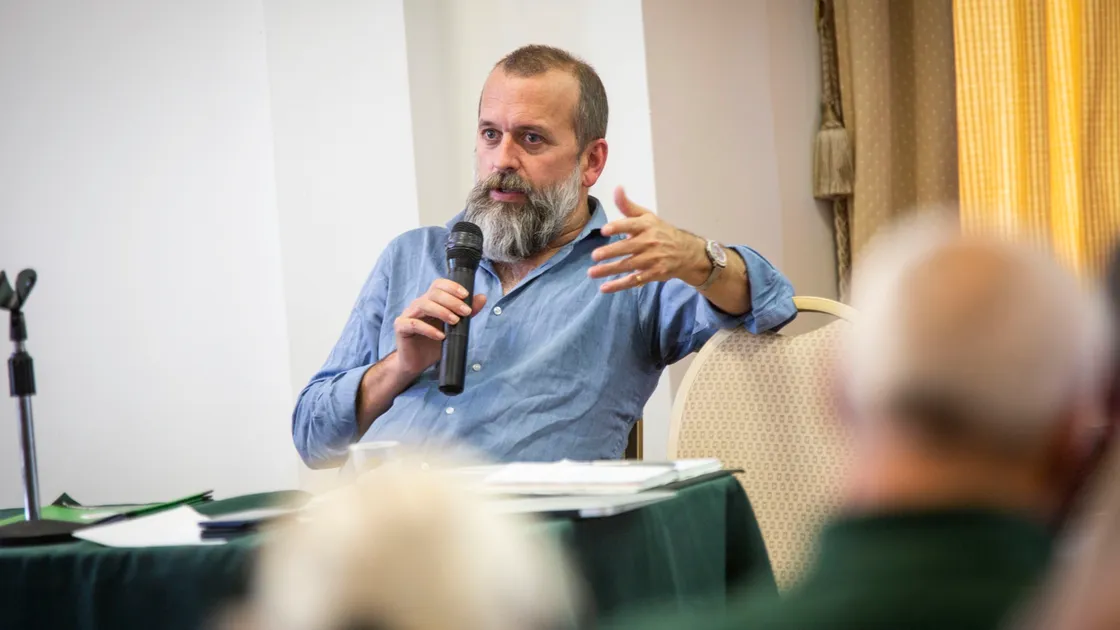
Pesticide regulation, lobbying and the revolving door: a conversation with Pesticide Action Network
#7 | September 2026
Published August 2026
Pesticide regulation, lobbying and the revolving door: a conversation with Pesticide Action Network
Ask most people to name a pesticide and, if you are lucky, you will get two answers: glyphosate, and “the ones that kill bees”. That is already progress. Twenty years ago, says Nick from the Pesticide Action Network UK (PAN UK), the public had almost no idea what pesticides were, let alone what they do to soil, water, pollinators and the people who grow our food.
PAN UK is the only British charity working on every aspect of pesticides, from international treaties down to the weedkiller sprayed in a local playground. In this episode of What The Field?! we sat down with Nick to understand a system that touches almost everything we eat and yet stays strangely invisible. The short version: regulation is slow, the lobby is fast, and the people paying the highest price are the farmers themselves.
Twenty years in, what has actually changed
Nick has spent two decades at PAN UK, and when we asked what has shifted most, he did not point to a law or a ban. He pointed to awareness.
That matters more than it sounds. Regulators and politicians, he argues, are finally accepting that something has to change, not only about individual chemicals but about industrial farming and the role it plays in biodiversity loss and water pollution. Understanding has grown. The regulation, unfortunately, has not kept pace.
Why pesticide regulation is always playing catch up
The central frustration of Nick’s work is speed. Regulation, he says, is “always playing catch up with the big issues”.
The clearest example is neonicotinoids, the insecticides linked to pollinator decline. It took more than a decade to ban them across the EU, despite the evidence stacking up the whole way through. A decade is a long time in the life of a bee.
Part of the reason is that the pesticide industry is not, in Nick’s blunt framing, in the business of helping farmers. “They’re interested in making profits for their companies. That’s their role.” Any opening to protect a product, defend a margin or roll back a rule tends to get used.
The industry playbook: lies, lobbying and the revolving door
One of PAN UK’s jobs is to debunk what Nick calls “the nonsense” the industry puts out, and there is a pattern to it. He offered two examples worth remembering the next time you hear a scare story about food security.
In 2009, as the EU debated a new hazard based approval system, the UK’s National Farmers Union, which Nick describes as “basically the political wing of the pesticide industry”, warned that if the rules passed, Britain would “never grow a carrot again”. The rules passed. Carrots are now one of the few crops the UK is essentially self-sufficient in.
When restrictions on neonicotinoids were proposed, the industry forecast losses of around 39 billion pounds and 60,000 jobs. The restrictions came in. Neither number materialised.
“It’s a good sign when they put these things out,” Nick notes, “because they know they’re under pressure.”
Behind the headlines sits a quieter problem: the revolving door. Politicians and civil servants who once oversaw farming or chemical policy move into industry roles, and industry figures move into the bodies that decide which pesticides get approved. It brings relevant experience, Nick concedes, and a large helping of conflict of interest. The result is a decision making process with, in his words, “a massive lack of transparency”, from approvals all the way to the advice a farmer receives in the field.
Why supermarkets, not politicians, move first
If regulation is slow, where does change actually come from? Nick’s answer is not romantic, but it is practical: retailers.
PAN UK works with the ten largest supermarkets in the UK. Many have gone beyond the legal minimum and banned highly hazardous pesticides across their entire global supply chains, which ripples out to growers in the global south and anywhere else they import from. Since Brexit weakened the UK’s maximum residue levels, several retailers have simply kept the stricter EU limits, because it is easier to run one standard than two.
Then comes the line that says the quiet part out loud.
"A politician is more likely to listen to the CEO of Tesco than they are to listen to me. Which is sad, but true."
The lever, in other words, runs through the checkout. Retailers respond to customers, and customers who ask for fewer residues and more organic produce push supermarkets to change their supply chains. It is a slower kind of power, but one that can route around a stuck regulatory process.
The yield myth
Few ideas are as sticky, or as useful to the pesticide industry, as the belief that we must keep pushing yields ever higher to feed the world. Nick calls it “a complete and utter fabrication”.
It was once true. At the end of the Second World War, Britain genuinely needed to grow more food. But the argument stuck long after the context changed, partly because it is very hard for a politician to stand up and say we do not, in fact, need more food. Much of the land in question grows feed for animals, biofuels or monocrops like sugar beet, not food for people.
The better measure of a good farmer, Nick argues, is not yield but income, and you can raise income by cutting inputs rather than chasing tonnes. He points to the Nature Friendly Farming Network, whose members are not organic but are reducing pesticides and fertilisers while improving their margins. One of the few upsides of Brexit, he adds, is the replacement for the old subsidy model: farmers are now paid public money for public goods such as clean water, healthy soil and biodiversity, including a payment for stopping insecticide use. It has proved popular.
What organic really means, and what it doesn’t
Is organic farming pesticide free? Not quite, and Nick is refreshingly honest about it. Organic growers can still use a limited toolkit, but the difference in scale is enormous: fewer than 20 active substances are approved for organic use, against 400 to 500 for conventional agriculture. And there is no prophylactic spraying. A farmer reaches for one of those substances only after other methods have failed and a real financial loss is at stake.
Not all of them are harmless. Copper, in particular, is problematic, and a few others carry risks. But the quantities are so small that, in terms of harm to human health or the environment, Nick puts organic and conventional “magnitudes of difference” apart.
There is a cocktail effect worth understanding here too. We do not ingest pesticides one at a time; we take in a mix of residues across a lifetime, and how those combine is still poorly understood. Switching to organic measurably lowers your dietary exposure. CrowdFarming’s own team looked into this and found that people moving to an organic diet can see a sharp drop in pesticide residues in their bodies within about 24 hours.
But Nick is wary of making organic all about personal health. That framing, he thinks, has actually held the movement back.
"To my mind, the point of organic is working with nature, improving biodiversity, and farmer health, because they're not being exposed."
The Dirty Dozen, explained
PAN UK’s best known consumer tool is the Dirty Dozen, an annual list of the produce most likely to carry multiple pesticide residues, drawn from the UK government’s own testing data. It is deliberately practical. Nobody expects a family to buy everything organic, so the list helps people spend where it counts, swapping the one or two items they eat most often.
Two honest caveats from Nick. The government tests only a limited range of products, and it changes what it tests each year, so the picture is indicative rather than comprehensive. And the point is not really the specific ranking. It is the reminder, once a year, that most of our food carries residues at all, and that the public has a right to know what is on it.
"If you ask any member of the public, 'Do you want to eat pesticide residues?', their answer will be no. It's hidden away. People have a right to know."
Glyphosate, the Omnibus and the fight in Brussels
PAN UK tends not to campaign against single pesticides, because banning one usually just clears the shelf for the next. Neonicotinoids are the cautionary tale: they were banned, everyone declared the pollinators saved, and yet plenty of other bee toxic substances are still out there. The system, not the molecule, is the problem.
Glyphosate is the exception, and a deliberate one. It is so well known, thanks in large part to its links with Monsanto, that it works as a hook to explain everything wrong with the approvals process: the industry science, the corporate capture, the lobbying. More than a million people signed a European petition to ban it. “You’re not going to get that for anything else,” Nick says.
The bigger fight now is in Brussels. The EU’s Omnibus package, marketed as a “simplification” of agrochemical rules, worries him a great deal, because it risks relaxing what has been the most precautionary pesticide regime in the world. His colleagues at PAN Europe are working on it daily and have concrete actions ready. His advice to concerned citizens is specific and unglamorous: write to your national politicians and your MEPs, and check the PAN Europe website for the campaigns running ahead of the autumn parliamentary discussions.
The What The Field?! moment: the farmers we forgot
We close every episode with the question the podcast is named after. What, in all his years, has most made Nick think, what the field is going on?
His answer was not a chemical or a loophole. It was a silence.
"The most shocking thing is the complete and utter absence of any attention on farmers being poisoned by pesticides."
He points to the sheep farmers poisoned in the 1980s by organophosphate sheep dips, which were mandatory at the time so that Britain could sell sheep to France. The official advice was, in his word, appalling. Hundreds of farmers died, or lost relatives, or developed Parkinson’s and other conditions, and the bodies meant to represent them looked away. Farmers, the people most exposed to pesticides and the people who grow our food, are still the last to be protected.
One book to read next
Nick’s recommendation is a classic, and a slightly depressing one, because it holds up too well. “Go right back to Silent Spring. It says everything you need to know, and sadly we’re still facing the same arguments, in some cases the exact same pesticides.” Rachel Carson’s 1962 book arguably launched the environmental movement. More than sixty years on, Nick’s point is that it reads like it could have been written yesterday.
Written by Emilia Aguirre
Emilia Aguirre is our Awareness & Advocacy specialist — which means she spends her days asking the uncomfortable questions about how our food is grown, priced, labeled, and sold. She hosts What The Field?!, a podcast packed with stories from the ground, hard-hitting research, and conversations with the people shaping the future of food (whether they like it or not).
Comments
Keep digging ...