
Looking for more? 

We’re just an email away.

40:14 min

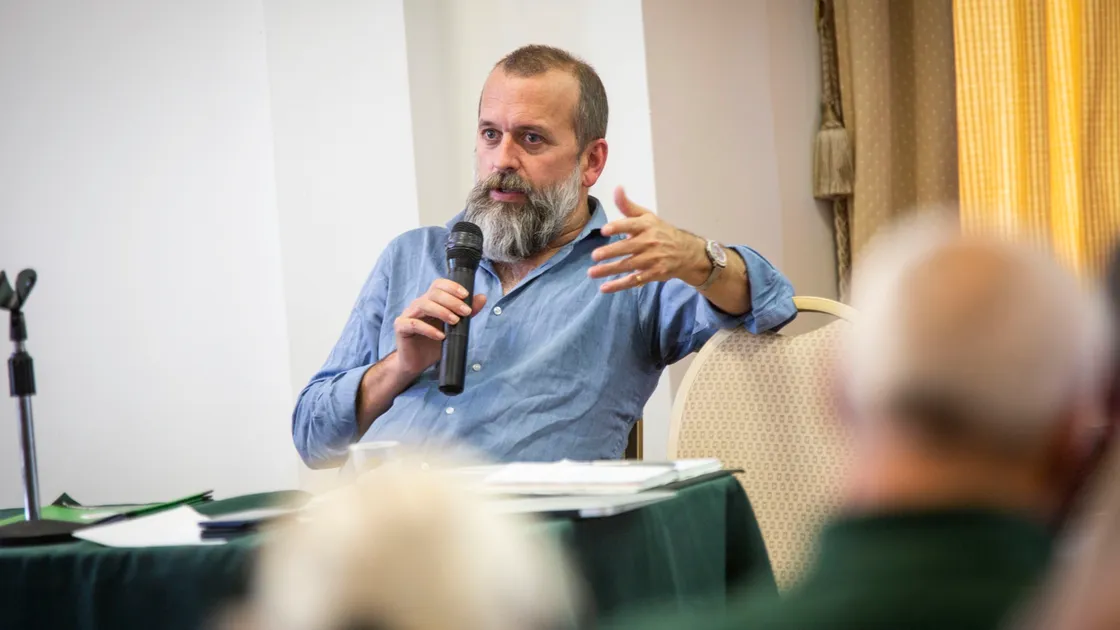
Nurturing nutrition, a conversation with Dan Kitteredge

# | July 2026

Society

40:14 min

Published June 2026

Nurturing nutrition, a conversation with Dan Kitteredge

Bionutrient Food Association founder Dan Kittredge on why organic certification is not a nutritional guarantee, what your tongue already knows, and the race to put a nutrient scanner in every smartphone.

Dan Kittredge grew up on an organic farm in the United States, the son of two founders of the American organic movement. He went on to become a farmer himself, then an NGO director, and eventually the person who coined the term “nutrient density” as we now use it in food systems conversations. For nearly twenty years, through the Bionutrient Food Association, he has been building the science to prove what many farmers and eaters sense intuitively: that not all food is equal, that the difference is measurable, and that the market has so far been rewarding the wrong things. We spoke about the gap between certification and nutrition, the physics of tasting well, and why he thinks a phone camera could change everything by 2030.

The first thing Dan Kittredge wants to dismantle is the assumption that organic means nutritious. It is, he acknowledges with some affection, the assumption he grew up with. His parents spent 35 years leading an organic farming organisation in the United States and helped write some of the country’s first organic standards in the 1980s. He sold potatoes and blueberries at the farmers market every Saturday morning as a child, nose in the air, certain they were better. “I’m standing on their shoulders,” he says, and he means it. But the science, when he eventually looked at it, told a more complicated story.

You come from an organic farming background and you’ve spent nearly twenty years questioning whether organic automatically means more nutritious. What did you find?

The first mistake is to think that organic is uniform. Food is not uniform. Anyone who has eaten a tomato off the shelf in January and a tomato off the vine in August knows the scale of that variation in their own mouth. Your tongue is a very sophisticated nutrient monitoring system. When something tastes better, not sweeter but more flavourful, it is more nutritious. And there is a massive variation in nutrient levels across organic produce, across regenerative, across permaculture, across local, across conventional. None of those categories is uniform. You cannot say that any of them is reliably better.

How did you come to understand that? Was there a moment when the question of nutrition became more urgent for you than the question of certification?

I was a farmer who couldn’t make a living. I had a young family, I was struggling with pest pressure, disease pressure, failure to thrive, and I was trying to figure out how to pay the bills. The questions I was asking were practical ones: how do I cause plants to not be pest and disease susceptible? And what I found is that the answer runs through the functionality of the soil life. Soil health is plant health is pest and disease resistance is farm viability is flavour is nutrition is human health. That is one interrelationship. And a lot of the practices I was brought up with in organic do not facilitate soil health. Just because you are not using chemicals does not mean you have optimised soil health. Just because you are cover cropping and no-tilling does not mean you are optimising soil health.

Can you give an example of how good intentions and good practices can still miss the point?

If the thing that is impeding soil health is aeration, if the microbes in the soil need air to breathe and your soil is tight and compacted, those microbes are asphyxiating. It does not matter if you have cover crops, it does not matter if you have not applied chemicals. The microbes cannot breathe and they are dead. Until you understand that microbes need air like chickens do, and you solve that specific problem, you will not have soil health. There are 85 different ways of solving that problem. But you have to understand the root cause and work systemically to address it.

A lot of what is happening in regenerative is a process-based standard. If you do these things, you claim regenerative. It is a bit like religion. If you do five Hail Marys, does that mean you are closer to God, or you have just done five Hail Marys? You have planted cover crops. That does not necessarily mean you have better soil health. Each piece of land is unique, it is alive, and only when you as a farmer are humbly listening and serving that land right here, right now, should you expect its vitality to increase.

You ran a major research programme sampling 10,000 crops across two continents. What did it find?

We sampled 25 different crops across hundreds of farms, and we overlaid soil metrics and management practices trying to tease out what actually causes nutrient variation. What role does genetics play? What role does soil type play? Fertility programmes, management practices, certifications, points of purchase? None of them seemed to correlate. You can take a bag of carrot seeds, plant them in ten different soils, and have massive variations in nutrient levels. You can take one field, manage it differently in different seasons, and have massively different nutrient levels. Organic versus not organic does not correlate. Local versus not local does not correlate. Soil type is not a causal factor. Genetics is not a causal factor.

The thing that connected to nutrient variation was levels of life in the soil. The function of the microbiome. The more well the land is functioning, the healthier the plant is, and the more nutritious the food that comes off it.

So it is not a snapshot of soil health at any given moment, it is about the whole life of the plant.

Exactly. You can take a soil test in April and that will tell you at one moment which nutrients are there and which microbes are there. But the plant grew from when it was planted to when it was harvested, and during that entire time it was experiencing life. Think of raising a child. If the first three years of that child’s life it eats macaroni and cheese, that is a formative time. Its bones are not going to be as dense as they could be. Its immune system is not going to be functioning well. For the rest of that child’s life it will not be as healthy as it could be, because what it experienced early on has a ripple impact. The functionality of life in the soil through the entire life of the plant is what seems to correlate to nutritional outcome.

What has caused the general decline in average nutritional quality over the last 75 years?

The market has been paying farmers based on volume and aesthetic. If you are a farmer and you want to make a living, you do not get paid on nutritional calibre. You get paid on kilos, on bushels, on tons, and on aesthetic uniformity. The market has been incentivising a set of practices that are in most cases antithetical to nutritional calibre. That is why the averages have gone down.

Though I want to push back on the idea that everything in 1950 was good and everything now is bad. There was always a full spectrum of variation at any point in time. What has changed is that the incentive structure has been driving the averages in the wrong direction.

And the data backs that up, even for farms that believe they are doing everything right.

The graphs are embarrassing, honestly. Almost all food is way worse than it could be. The bar is embarrassingly low for everything. The opportunities to improve are everywhere and it is not hard to do way better. It is just a question of who wants to take the first step and how we can work together. And let us start with humility. Do not start being cocky and arrogant: “I am organic, I am better. I am regenerative, I am better.” Let us build an open data base. Let us have a scientific framework where we all agree this is a scientific process, we are getting our dogmas out of the way, and we are just measuring.

Your research has also taken you in a more unexpected direction, making the case that the human palate is actually a reliable instrument. How does that work?

Around 30% of our DNA is associated with the function of our nose and our tongue. That is not an accident. The compounds we call flavour and aroma, polyphenols and terpenoids, only get built in the plant in high levels when everything else is present. When the full biochemical complexity, all the vitamins, all the enzymes, everything else is present, only then can the plant build these flavour compounds. So being able to taste and smell well is essentially evolution’s way of telling you: if you eat this, you will be more well, and your children will be healthier.

And if you follow that track forward, that is where we are now. Three or four generations post the Green Revolution, we have been building our bodies out of insufficient substance. We have children, and their bodies are built even less well, and then less well again. We have epidemic levels of chronic disease because we are physiologically degenerating. Our nutritional status is getting weaker and weaker. It takes time for life to wear out. But you can build it back up. If you start eating well, it reverses. Your body is essentially renewed every six months.

You have also been developing instruments to measure nutrient density more precisely. Can you walk us through what you have built?

One is a handheld spectrometer we built in 2017 and calibrated with those 10,000 samples. It is very rudimentary, 3D-printed case, screws, built-in-a-garage kind of thing. But we were able to get a paper published in Nature Scientific Communications showing that when it flashes light at a carrot, it can read the level of antioxidants in that carrot, and send the reading via Bluetooth to your smartphone. You can flash the light at a courgette and get a reading on polyphenols. Flash it at wheat berries and get the protein level. That is where we are going: when the research is complete, it will be the camera in your phone.

You pull your phone out of your pocket, you flash a light at three different brands of carrots on the shelf, you see the readings, and you choose. You are reading the carrot, not the QR code, not the label. And if you get a better reading from one source consistently, you tell your friends. Everybody in town will know pretty quickly which products are performing and which are not.

Brix was actually named after the Austrian chemist who solved a problem the German vintners posted as a prize challenge in the 1830s: why do some grapes make great wine and others make vinegar? Brix figured it out and the measurement was named after him, just as Celsius, Fahrenheit, Richter, Ohm and Volt had scales or units named after them.

The spectrometer research is more expensive. Who funds that kind of work, and who should?

The reason this research has not been done is that no one with deep pockets has found it to be in their economic advantage. The player with the best interest is us, the people. If it costs around 800,000 euros per crop to build the nutritional standard, and you have 100,000 people who care, that is eight euros per person. Eight euros for blueberries this month, eight euros for apples next month.

What we have noticed is that what drives people above everything else is the health of their children. If you are a parent, the health of your children takes precedence over pretty much everything. And what will drive real change is a guarantee that the product you are buying is actually healthier for your family, backed by science you can hold in your hand.

You also believe big food companies are beginning to pay attention.

I am in boardrooms and corporate headquarters of some of the biggest food companies on the planet. What many of them have come to understand is that this whole movement is coming, and they do not want to be embarrassed when people can measure. Whichever large food company decides first to move to improve the nutritional calibre of its supply chain, when we are able to measure, they are going to gain market share. They will have better supply chain resilience, better ecosystem impact, better flavour, a much better marketing strategy. Those who want to move and evolve will be more profitable. Those who want to be recalcitrant will lose market share.

By what timeline do you think this could be available as a consumer tool?

By 2030 it is entirely plausible for dozens of crops, if the research funding comes through. We can do the research per crop in around six months, and we can run twenty crops at once, if we have the resources. The momentum is building. It feels imminent.

What would you say to consumers right now, before any of that technology exists, who want to make better choices?

What has your family made of the direction your work has taken, given that they helped build the organic movement you are now complicating?

I think they are maybe secretly a little bit proud. Secretly, though. But I think they should be proud of what they did. They helped make organic a thing when it was not a thing. I am only able to do this work because of the background and perspective they gave me. And the base they built matters. No chemicals is a huge step forward from chemicals. On principle, the application of toxic chemicals is counterproductive to overall system function. It is just not sufficient on its own.

What I try to say is: those who live in glass houses should not throw stones. Until you have an optimally functioning biological system, do not bother judging others. Be humble and ask how you can do better. It is much easier to judge others. But it is not helpful. And right now, we need all of us at the table.

Written by Emilia Aguirre
Emilia Aguirre

Emilia Aguirre is our Awareness & Advocacy specialist — which means she spends her days asking the uncomfortable questions about how our food is grown, priced, labeled, and sold. She hosts What The Field?!, a podcast packed with stories from the ground, hard-hitting research, and conversations with the people shaping the future of food (whether they like it or not).

Comments

Your email address will not be published.

Share this content:

Keep digging ...

Society

48 min

Getting Healthy in Toxic Times with Dr. Jenny Goodman

#3 | June 2026

Dr. Jenny Goodman trained as a conventional medical doctor before spending decades building a practice in ecological medicine, a field that takes nutrition, environmental toxins, and root causes seriously in a way that mainstream medicine, she argues, simply does not. She is the author of Staying Alive in Toxic Times and Getting Healthy in Toxic Times. We spoke with her about pesticides, the gut microbiome, why governments won’t protect us, and what we can actually do about it.You trained as a conventional doctor, went through all of that, and then walked away from it. What happened?It was much sooner than most people expect. Probably within the first year or two of medical school, I knew something was wrong. I couldn’t put my finger on it, but the moment of real disillusionment came at the start of the third year, when we were finally meant to meet patients and learn the arts of healing. I thought: now I’ll understand what all that anatomy, physiology, and biochemistry was for.Instead, the word “healing” was taboo on the wards. The word “cure” was taboo. What they talked about was managing symptoms — suppressing them with drugs, then adding more drugs to manage the side effects. Nobody went home well. Nobody went home healthy. The World Health Organization defines health as a state of complete mental, physical, and spiritual wellbeing. It’s not just that they never achieved that — they weren’t even aiming for it, and they would have been embarrassed if you mentioned it.There was also no attempt to look at root causes. I would ask: why has this 40-year-old man had a heart attack? Why has this woman of 45 got liver cancer? And not only did they not have answers — the question itself was taboo.Did you find anything within conventional medicine that worked for you?Emergency medicine. I liked it because I didn’t disagree with what was happening. Conventional medicine is brilliant at emergencies — you break a bone, you have a heart attack, in that moment, that’s what you need. I felt I was doing the right thing. But I didn’t want to do it forever.What eventually changed everything was discovering the British Society for Ecological Medicine in the late nineties, about 17 years after I’d qualified. These were doctors doing the kind of medicine I had imagined I was going to learn as a 19-year-old. They were getting to root causes, making people better, and not making them worse.So what actually is ecological medicine?It has two halves. The first is nutrition — identifying what good substances are missing from our bodies, understanding why they’re missing, and putting them back. The second is environmental medicine — identifying which industrial toxins have entered our bodies and teaching people how to avoid them going forward. And those two halves are deeply connected, because a lot of why we’re nutritionally depleted comes back to farming.The reason it’s called “ecological” is twofold. First, we see the whole body as one joined-up ecosystem. In conventional medicine, if you go to your GP and say you have joint pain, a rash, and trouble breathing, they’ll send you to three separate specialists who have no way of connecting with each other. The body is a whole. We look at what is causing inflammation to manifest across all those different systems.But it’s also ecological in a broader sense: the human body is not just an ecosystem, it is part of the ecosystem of planet Earth. This isn’t vague, new-age language. It’s basic biology, physics, and chemistry. Whatever we put into the air, we inhale. Whatever we put into the water, we drink. Whatever we put into the soil is taken up by the plants, ends up on the plate, and gets into our bodies — including our gut microbiome. There is no separation. We cannot poison the planet without poisoning ourselves.You’ve said that farmers hold the keys to public health solutions. Why?Because the connection is direct. If farmers are growing food in nutrient-depleted soil using synthetic fertilizers that don’t contain the minerals we need — no magnesium, no iodine, no chromium, no zinc, none of the things I find people desperately deficient in after 26 years of practice — then the food on the plate is nutritionally depleted too. And if they’re using pesticides, those pesticides kill the good bacteria in the soil, which are responsible for getting nitrogen and minerals into plant roots. You don’t just get poisoned crops. You get nutritionally empty ones.Everywhere I go, farmers are desperate to convert to organic and regenerative. There is no ideological problem. There’s an economic problem in making the transition. But once they’ve made it, they save money — they’re no longer spending on synthetic pesticides and fertilizers. The issue is that governments need to subsidize the transition to small-scale, human-scale, organic, regenerative family farming, instead of subsidizing agribusiness.Our research found that around 84% of Europeans have at least two or three different pesticides in their system at any given time. What is that actually doing inside the body?I should start with detox, because we do have ways of clearing these things — but let me explain the mechanisms first, because they’re worth understanding.Most insecticides and pesticides are cholinesterase inhibitors. To understand why that matters, you need to know how nerve transmission works. When an electrical impulse travels through your nervous system, at every synapse — every gap between nerve cells — it briefly becomes a chemical signal. The neurotransmitter responsible for that chemical crossing is acetylcholine. Once it has done its job, it has to be destroyed, otherwise the system gets stuck in the “on” mode and becomes paralyzed. The enzyme that destroys it is called acetylcholinesterase.What pesticides do is destroy that enzyme. The system can’t reset. It gets stuck. And that is one of the major mechanisms behind neurological deterioration — Parkinson’s, multiple sclerosis, motor neuron disease, and Alzheimer’s.And this isn’t a fringe hypothesis. When I started writing my second book, I thought: I hope I can find half a dozen studies connecting pesticides to these diseases. I was overwhelmed. There are tens of thousands of studies, in peer-reviewed scientific and medical journals, showing strong links between pesticides and Parkinson’s, MS, ALS, and most forms of cancer.Where do these chemicals come from, in terms of their original chemistry?Their chemistry is based on nerve gases used in the World Wars — particularly the Second World War. Come 1945, the manufacturers couldn’t sell those products anymore. So they converted them, first into insecticides, then herbicides, fungicides, and so on. It is essentially the same chemistry, slightly modified, that was used to kill human beings. These are biological weapons. And of course they kill wildlife, disrupt soil bacteria, harm mammals, and harm us.You also mentioned endocrine disruption as a third major impact area.Yes. Some pesticide molecules structurally resemble estrogen. They sit on estrogen receptors in the body and trigger estrogenic effects. Many heavy metals — aluminum, nickel, mercury, cadmium — appear to do something similar.The results are already visible in wildlife: feminization of male fish in rivers, dramatic drops in fertility across mammals, birds, reptiles, and fish. And in humans: sperm counts across the Western world have been falling for decades. There’s a classic Danish study comparing sperm counts in organic versus non-organic farmers. The organic farmers had excellent sperm counts and healthy children. The non-organic farmers had worryingly low ones.In my practice, so-called “unexplained” infertility was one of the most common things I saw. When you get the nutrition right and identify and detox the heavy metals and pesticides, couples can often conceive within a year. And the damage doesn’t stop with one generation. These chemicals can be adducted — literally stuck onto DNA, from both egg and sperm — and passed on. We’re talking about multi-generational damage.Glyphosate comes up constantly in this conversation. Is it really as dangerous as people say?The World Health Organization classifies glyphosate as a carcinogen. Monsanto Bayer’s defence has been that the metabolic pathway glyphosate interferes with in plants doesn’t exist in mammalian cells. That’s technically true. But it does exist in the bacteria in our gut. And the microbiome isn’t an optional add-on — it’s as vital as the liver or the kidneys. Glyphosate poisons it, and therefore we get sick.There’s also something deeply troubling about its molecular structure. Glyphosate is structurally very similar to glycine, an essential amino acid that forms part of our connective tissue — tendons, ligaments, collagen. It’s biologically plausible that in people with insufficient protein intake, the body could substitute glyphosate for glycine in collagen molecules, which would compromise their structural strength. Nobody has funded that research. Who would?In the meantime: if you’re not making your own bread from organic flour, your children are eating glyphosate every day.What can people actually do?First: eat organic. When people switch, I consistently see their health transform. After a few months, they stop needing supplements because they’re finally getting the nourishment from food, as we always used to.On affordability — the criticism is valid, but the framing is misleading. Mass-produced cheap food is effectively subsidized because the environmental damage it causes isn’t factored into its price. If we charged the real cost, organic food would win the comparison easily. There are also practical adjustments: if you eat chicken three times a week, switch to organic and eat it once a week. One organic chicken costs less than three battery ones. And think of it as health insurance. Getting cancer is extraordinarily expensive — in lost income, in treatment, in suffering.Second: filter your water. In many parts of Europe, unfiltered tap water contains residues of pesticides, fertilizers, hormones from HRT and contraceptives, antibiotics, heavy metals, and chlorine. A good water filter removes most of this.Third: avoid pesticide contact outside of food. Pet flea treatments are a major and underestimated source — most of them are insecticides, regardless of the trade name. Ask your vet directly. Local authority grass verge spraying is another exposure route, especially for young children. Campaigns to stop unnecessary spraying have gained real ground in recent years.For detox, there are seven approaches I outline in my books: high-dose vitamin C; organic vegetable juicing; Epsom salts baths; short saunas — critically, five minutes only, and wipe the sweat off continuously rather than letting the body reabsorb it; specific supplements like phosphatidylcholine (found in egg yolk) and glutathione; colonic hydrotherapy for some people; and sprouting seeds on your windowsill. Tiny two-centimetre broccoli sprouts contain up to 50 times the nutrient density of a mature broccoli head.Why hasn’t any of this been acted on at a government or industry level?In one word: capitalism. These products are highly profitable, and the companies that make them have the resources to counter independent research with their own. The pattern is the same with every pesticide: it’s introduced, then banned 10 years later when the evidence becomes undeniable. The companies say they’ll go back to the drawing board and make a safer version. Then that one gets banned too.As for governments — they are not neutral parties. Ministers hold shares in these companies the same way they hold shares in pharmaceutical companies. The regulatory authorities that are supposed to control this industry are staffed by people who have worked for that industry. It’s the revolving door. Accepting this was genuinely disillusioning for me, but the evidence is plain.The only people who are going to protect us are ourselves. Through food choices, through campaigning, through teaching the next generation — including that the level of illness we’re seeing, in children as well as adults, is not normal, not natural, and not necessary.

Listen

Society

50 min

Bringing back the buzz with Dave Goulson

#2 | May 2026

Entomologist Dave Goulson on vanishing insects, pesticide-laced bedrooms, and why the fate of bees and humans are more intertwined than we’d like to think.Dave Goulson has spent his entire career studying insects and watching them disappear. Professor of biology at the University of Sussex, founder of the Bumblebee Conservation Trust, and author of more than a dozen books, his latest, Eat the Planet Well, published on the day of this recording, is a guide to eating sustainably that connects the food on our plates directly to the crisis unfolding beneath our feet. We spoke about the staggering scale of insect decline, the agrochemical industry’s grip on farming, and why your messy garden might just be a small act of resistance.The first thing you need to know about Dave Goulson is that his love of insects is not something he can explain rationally. It began at primary school, collecting caterpillars from the edge of the playing field and bringing them home in an empty lunchbox to keep in jam jars on his bedroom windowsill. Most of them died, he admits, but some survived, including a set of tiny yellow and black striped caterpillars that became cinnabar moths, brilliant red and black. “I just thought that was really cool,” he says, with the tone of someone who still thinks it’s really cool, four decades later.It’s a disarming quality, that unguarded enthusiasm, in someone who also has to regularly deliver some of the bleakest statistics in contemporary science.The scale of what we’ve lost is difficult to comprehend. Where do we actually stand?All the evidence we have suggests insects have undergone a pretty massive decline, and that it’s still ongoing. It’s quite hard to put accurate figures to it because the data we have are really patchy. We don’t have a global insect monitoring network, which would be ideal. We only really started monitoring any insects in the 1970s, which was probably long after they started declining. But a reasonable estimate is that in Europe we may have lost 90% of our insects in terms of abundance over the last hundred years. We can’t be entirely sure of that figure, but that’s where the evidence points.The causes are numerous. The biggest one is habitat loss driven by the industrialisation of farming, and associated with that, all the chemical inputs, particularly insecticides, which are designed to kill insects, so it’s not really surprising that they’re driving insect declines. Then there are invasive species, like the yellow-legged hornet from Asia, which is sweeping through Europe and decimating wild bee populations. Climate change is starting to kick in. Light pollution affects nocturnal insects. It’s a perfect storm of problems, all of them manmade, that insects have to deal with.It’s worth pointing out: insects are pretty tough. They’ve been around for nearly half a billion years, twice as old as the oldest dinosaurs. They survived mass extinction events, including the meteor that wiped out the dinosaurs. So it’s quite telling that after all of that, they’re now struggling because of us, in the blink of an eye, really, in the last hundred years.You live in a rural part of southeast England, exactly the kind of place you’d expect to be full of wildlife. What do you actually see when you step outside?There are still butterflies and birds and some wildflowers, but there’s an awful lot of bugger all, to be honest. Even ten years ago I remember hearing skylarks singing. There aren’t any skylarks anymore. Cuckoos, occasionally in the spring. I don’t hear those either. Both feed at least partly on insects. That’s one of the many knock-on effects of declining insect populations: things that rely on them for food are obviously also declining. It’s a bit disheartening at times.For someone who lives in a city, it’s possible to go through life and genuinely not notice any of this. How do you explain why it matters?We’ve become an urban creature, and it’s really easy for people to be completely disconnected from nature, not realising that we are still part of nature, that we all depend on food, which has to be grown in a healthy ecosystem. It needs soil, it needs pollinators, it needs insects to recycle.There’s a whole list of things insects do that we can’t do without. Lots of creatures eat them, creatures that people value, like birds. Most bird species, plus bats, fish like salmon and trout, most amphibians and reptiles, they all depend on insects for food. Beyond that, insects control crop pests, recycle dung and dead matter to release nutrients for new growth, and help keep soil healthy. And then there’s pollination, which has at least seeped into public consciousness. People know, roughly, that bees pollinate plants and without them we’d have less fruit and veg. That’s broadly true. Three-quarters of the crops we grow wouldn’t give a full harvest without being visited by some kind of insect.Though often it’s not a bee. It might be a butterfly, a moth, a hoverfly, a wasp, a beetle. There are thousands of species of insect that pollinate. A nice example is cacao, which gives us chocolate, pollinated by tiny little midges, the only things that can get through the small entrance of the flower. Bees can’t get in at all. So for chocolate, at least, bees are entirely irrelevant. No midges, no chocolate: that’s probably a better marketing campaign than most things I’ve heard.Your new book, Eat the Planet Well, might seem like a departure for someone known for studying bees. What’s the connection?It’s become pretty clear to me that our fate and that of insects are intertwined. A lot of the things driving insect declines are also affecting us. Pesticides affect bees, but they’re also in our food, and there’s clear evidence that human exposure to pesticides is harmful to health. And broadly, I think the industrialisation of agriculture is not sustainable. It’s the biggest driver of biodiversity loss. One recent estimate suggests 40% of the world’s soils are now badly degraded. Food growing, processing and transport is a massive contributor to climate change.The system we have can’t carry on. The planet can’t cope, especially with a growing human population. We need to ask: how do we come up with a better system that actually feeds eight billion, soon probably ten billion, a healthy diet without destroying the planet? If we can answer that, then we can save the bees and everything else. It’s all intertwined.We often talk about the Green Revolution as a mistake, but at the time it was a genuine solution to a real problem.I completely agree. It’s easy to see why we adopted these practices. There was a time when people were hungry, when food was rationed across much of Europe. Producing more food obviously seemed like a good idea. But the way we’ve done it, we’ve done too much. The irony is it’s been so successful that we now massively overproduce crops and have become incredibly wasteful. Roughly a third of all food grown is wasted. And we do far too much animal farming. Something like 77% of all the world’s farmland is devoted to producing meat, which provides about 18% of our calories. The logic just isn’t there.If you’d started from scratch to devise a way to feed eight billion people efficiently and healthily, you would definitely not have arrived at the system we have today.A lot of that system is held in very few hands.It’s all wrapped up by a very small number of companies these days. There have been various buyouts and mergers. I think there are a couple more in Asia, but yes, it’s Bayer, Syngenta, Corteva, a tiny number of players who between them control the fertilisers, the pesticides, the GM crops, the seed patents, and increasingly the curricula in agricultural universities as well. They’ve tied farmers into a high-input, high-output system that makes some people very rich but is destroying the planet.Let’s talk about pesticides specifically. We recently covered research showing that 100% of urine samples tested in Spain contained pesticide traces, regardless of diet.And in most of those samples, it wasn’t just one pesticide. Many people are walking around with dozens of pesticides in their bloodstream, in their urine. We are basically guinea pigs in a huge experiment. Nobody was ever exposed to a cocktail of pesticides from conception to death until the generation born around 1940. And we’re all now continuously exposed to an ever-changing mixture for decades at a time.The safety testing done before pesticides are released is nearly always short-term toxicity studies, usually just a few days of exposure. That tells you nothing about a lifetime of exposure. And yet there is growing evidence of links between particular pesticides and all sorts of ill health, particularly in farmers, who are more exposed than most. Parkinson’s disease is now regarded essentially as an occupational disease of farmers. Paraquat and chlorpyrifos have been very strongly linked to Parkinson’s and other neurological problems.It almost doesn’t require a scientific study to conclude that products designed to kill living organisms might not be great for human health.No, not at all. I was actually one of the authors of a large review paper recently, where researchers looked at essentially every trial ever published on the impact of any pesticide on any organism. One of the really interesting findings is that each class of insecticide doesn’t just affect its target. Insecticides are obviously toxic to insects; that’s the point. But they’re also toxic to vertebrates, to plants, to soil microbes. Herbicides, which you’d think wouldn’t particularly harm insects, turn out to do so as well.They’re biocides. And if you reflect on where the first pesticides came from, many of the organophosphates were developed during the Second World War by people trying to create chemicals to kill people. When the war ended, they were repurposed for crops, and apparently no one stopped to ask whether that was a good idea.The regulatory system seems spectacularly unfit for purpose.It takes decades, typically from the moment a warning is first flagged by a scientist to the point where enough evidence has accumulated, enough researchers have attended to it, and governments have actually listened and acted. A minimum of twenty years for anything to happen. Meanwhile, hundreds of new pesticides have been introduced to the market. In Europe there are currently around 450 different active ingredients available to farmers; in the United States it’s closer to 1,000. The vast majority have never been independently evaluated for safety.And the companies that produce these pesticides lobby very hard to prevent any improvements to the regulatory system. They don’t want it to filter out harmful products. It would be more expensive for them if the tests were more rigorous. They’ve done a really good job of blocking reform. There have been many attempts to tighten the European pesticide system, and they’re almost invariably blocked by industry.It’s much like smoking. The tobacco industry managed to cast doubt on the link between smoking and cancer for nearly fifty years before it became impossible to deny. We’re in a similar situation with pesticides. It’s pretty obvious they’re doing us significant harm, but the lobbying in the other direction makes it very hard to persuade governments to act.There’s also a problem with the testing itself. Chemicals are assessed individually, not in the combinations people are actually exposed to.We should somehow test the mixtures, but the trouble is it’s almost impossible to do, because the number of possible combinations is near-infinite and everyone is exposed to a slightly different cocktail. You’d need billions of dollars to even begin to scratch the surface. And those who have billions of dollars are, of course, doing the opposite kind of testing.A lot of the farmers we work with feel they simply can’t transition away from these products, that they’d lose their crops. How do we change that?That’s a real barrier, and it’s not irrational. You can’t just stop using pesticides overnight and go organic. If you do, you’ll probably lose your crop. You need to adapt the varieties you’re growing, you need to give time for the natural enemies of pests, whose populations have been depleted by decades of spraying, to recover. It’s not simple.But there are successful organic farmers out there, and one of the most effective ways of persuading other farmers to try it is simply taking them to see a working, profitable organic farm. If they can see it working somewhere, and talk to a farmer who’s actually done it, they’re far more likely to believe it than if they hear it from an academic like me. No farmer would listen directly to what I have to say. Probably quite right, to be fair.The other part of the problem is agronomists. They’re supposed to give farmers impartial advice about how to grow their crops. In the UK, the large majority either work on commission or are directly employed by pesticide companies. They’re not impartial. And they’re also incentivised to recommend spraying: if they advise a farmer to spray and the crop still fails, the farmer is unlikely to blame them, at least they tried. If they say don’t spray and the crop fails, they’ll be blamed. So they’re conditioned to recommend spraying regardless of whether it’s strictly necessary. A critical component of a better farming system would be a network of independent agronomists that farmers could actually trust.You’ve spent much of your career on bees specifically. How many bee species are there, actually?Globally, 21,000 known species, and probably more awaiting discovery. In the UK alone there are 270 species. Of those 21,000, honey is made by a small number, mainly the honeybee, Apis mellifera, which is the domesticated species kept all over the world. There are about a dozen honeybee species globally that make honey, and a few stingless bee species in the tropics used on a small scale, mainly for medicinal purposes. But the bulk of honey does effectively come from one species.The large majority of bees don’t make any honey at all because they’re solitary. There’s no hive with a queen and thousands of workers, just a female that makes a nest on her own, and males that fly around trying to mate. If you go into a garden with flowers on a sunny day and spend five minutes watching, it quickly becomes obvious there are loads of different types of bee. In my garden right now you could probably find eight different bumblebee species. And yet most people think there’s one bee, it lives in a hive, it makes honey. If you ask them to draw it, they’ll draw something fat with yellow and black stripes, which honeybees aren’t. The cartoon bee is a bumblebee.On insect hotels, useful or not? I’ve had conflicting information.They can definitely be useful. I have about fifteen nailed to my house. They get occupied, particularly in urban areas. Most of mine have bees in them, maybe six or seven species. A few weeks ago there were loads of red mason bees, which are about a hundred times more efficient than honeybees at pollinating apples. So they’re supporting genuinely useful pollinators.There are downsides. They can become hotspots for parasites and diseases, so some people recommend cleaning them or replacing them periodically. I take a slightly more relaxed attitude, because I’m not trying to maximise my bee population. I’m happy for there to be parasites; they’re part of biodiversity. And frankly, I love sitting with a coffee watching my bee hotels in the morning.Bear in mind that these bees naturally nest in holes made by beetles burrowing in dead tree trunks. The modern world has very few slowly decaying trees with beetle holes in them. They’re tidied away and burned. So these bees probably struggle to find places to nest unless we give them somewhere. On balance, I think they’re a positive thing.What can individuals actually do? Is there genuine reason for optimism?The good news is that insect populations can recover really quickly. They’re not pandas or rhinos, breeding slowly. Give them the right conditions and their numbers can shoot up in weeks or months. And there’s a surprising amount of diversity hiding in urban spaces.There was a woman called Jenny Owen who lived in Leicester, not a city particularly famed for its biodiversity, with a small garden, about a sixteenth of a hectare. She spent 35 years cataloguing every species she could find: plants, birds, insects, spiders. After 35 years, she had found 2,673 different species in her urban garden. Nearly 2,000 of those were different types of insect. And that’s in northern England. Someone in Spain or southern France would find considerably more.The steps to get there are simple: don’t use pesticides, grow some native wildflowers, have a pond, don’t mow the lawn too often, put up a bee hotel. Many of those things save you time and effort. And there’s a cultural shift happening, which is genuinely encouraging. A lawn that was previously seen as “abandoned” is now being reframed as “rewilding.” There are still people who complain when road verges aren’t mown, but there’s a growing number who love it. In the UK there are 22 million private gardens covering around 500,000 hectares. If the majority became even modestly wildlife-friendly, that would matter enormously. And if we could get councils on board, road verges, roundabouts, parks, cemeteries full of wildflowers and pesticide-free, that would really help. It wouldn’t solve everything, but it would be a meaningful step with very little downside.You mentioned light pollution earlier. I hadn’t come across that one as a significant factor.It’s quite a new topic. The most obvious effect is moths and other nocturnal insects flying round and round streetlights and bashing themselves against them, which clearly isn’t good, and they’re being picked off by bats while they do it. But more recent research suggests other effects beyond just disorienting flying insects. Many insects judge when to emerge from hibernation by the lengthening of days. If they’re near a light that’s on all night, they may lose the ability to detect day length and emerge in the middle of January.There’s a wonderful, slightly obscure example: an African dung beetle that navigates by the Milky Way when rolling balls of dung. The line of the Milky Way tells it which direction to roll towards the hole it’s dug. If there’s light pollution, it can’t detect the Milky Way, and it wanders in circles. It’s a sad illustration of how many unintended effects we have on the world.It’s also a reminder of just how interconnected everything is. A beetle using a galaxy as a compass.It is remarkable. The insect world is full of strange and wonderful things, some of them quite disgusting, but many of them fabulous in their own peculiar ways. And there are thought to be millions of species we haven’t yet named. Who knows what we haven’t discovered.Finally: what has made you think, “What the field?” lately?There are so many things to choose from. The one that springs to mind is a paper about cores taken from glaciers in Svalbard, north of Norway, somewhere you’d imagine would be the purest place on the planet. They screened those cores for pesticides. There are layers of pesticides in the snow, corresponding to different periods of use further south, drifting in the atmosphere and depositing as snow at the poles. I just couldn’t quite believe that our impact had extended even to places where nobody ever goes. They’re still being poisoned by pesticides. How depressing is that.And there was another one. Researchers in the Netherlands screened dust from bedroom floors for pesticides. The average bedroom had 43 different pesticides in the dust lying on the floor. I don’t know what inspired someone to test that, but there it is. We’ve contaminated everywhere. What are we doing.Eat the Planet Well by Dave Goulson is out now. His documentary recommendation: My Garden of a Thousand Bees, available on streaming platforms.

Listen