

Published August 2026
The profitability of soil regeneration
Read the full report here
For years, the conversation around regenerative agriculture has focused on biology, climate and biodiversity. Yet one question ultimately determines whether a farm can be sustained over time: do the numbers add up? Our new report, Wealth Beneath Our Feet, quantifies the economic impact of the transition from degraded to living soil, based on public data and peer-reviewed studies.
The problem isn’t about producing: it’s about making money (and it’s getting harder and harder)
Europe remains highly productive, yet margins are tightening. In 2022, the value of EU agricultural production reached a record high, driven mainly by rising prices, amid sharply increased costs for energy, fertilisers and feed. In the years that followed, pressures mounted: productivity per worker and real farm income declined. This trend was reinforced by an unequal food chain, where farmers receive only 8% to 25% of the final price, a share that continues to fall.
The result is a trapped industry: producing more doesn’t always mean earning more. In fact, in 2024 there was a little more volume, but the total value fell because prices went down.
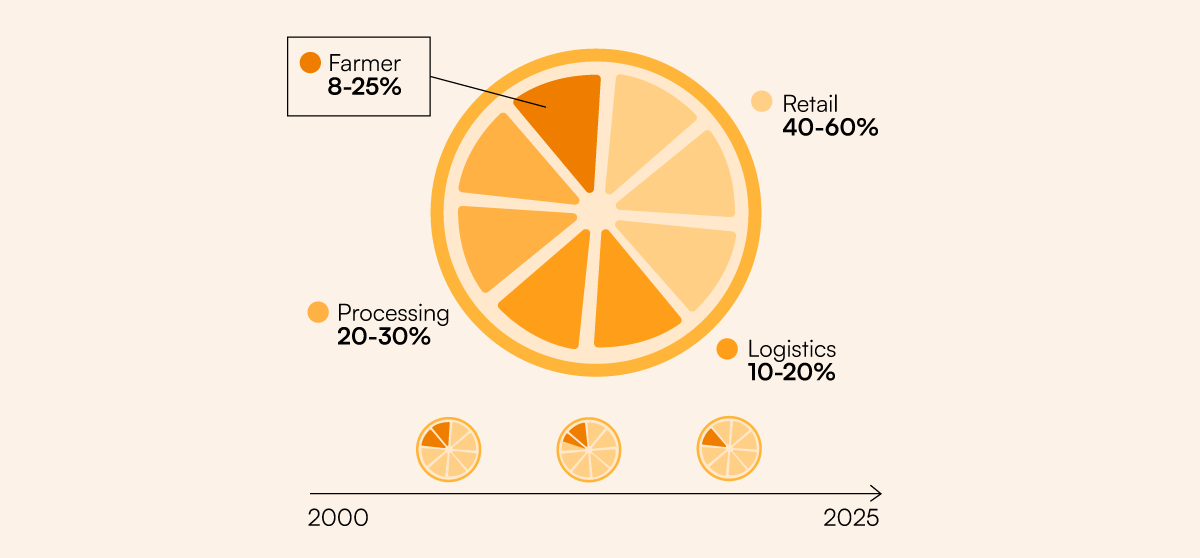
Figure 1. In most European food chains, the portion of the final price that goes to farmers is small—between 8% and 25%—and has been declining over time. Retailers often account for between 40% and 60% of the value. (OECD & FAO, 2023; Heinrich Böll Stiftung, 2025).
Degraded soil: the invisible bill
Under this economic pressure, there is one ‘balance’ that hardly ever enters the accounts: the soil. Between 60% and 70% of soils in the EU are not healthy, and more than 80% of agricultural soils exhibit at least one major form of degradation, such as erosion, compaction, carbon loss or contamination. In Mediterranean regions, organic carbon levels in many soils have dropped below 1%, far below the threshold required to sustain soil structure, water infiltration and fertility.
Put simply: degraded soil behaves like a depreciating asset. It produces less, requires increasing corrective inputs (fertilisers, irrigation, machinery) and heightens risk in challenging years.
Regenerative as an economic decision: the minimum ROI (return on investment)
The report adopts a deliberately prudent framework and assesses profitability without factoring in CAP (EU Common Agricultural Policy) aid, carbon payments or trade premiums. It only measures what happens within the farm:
- Direct input savings: approximately €190/ha/year, primarily from reduced synthetic fertiliser and pesticide use.
- More resilience = fewer losses: approximately €360/ha/year by reducing yield variability when the soil behaves like a high-quality soil.
- With a conservative transition cost of €2,000/ha, the estimated minimum ROI is ~27.5% per annum, with a payback of ~3.6 years.
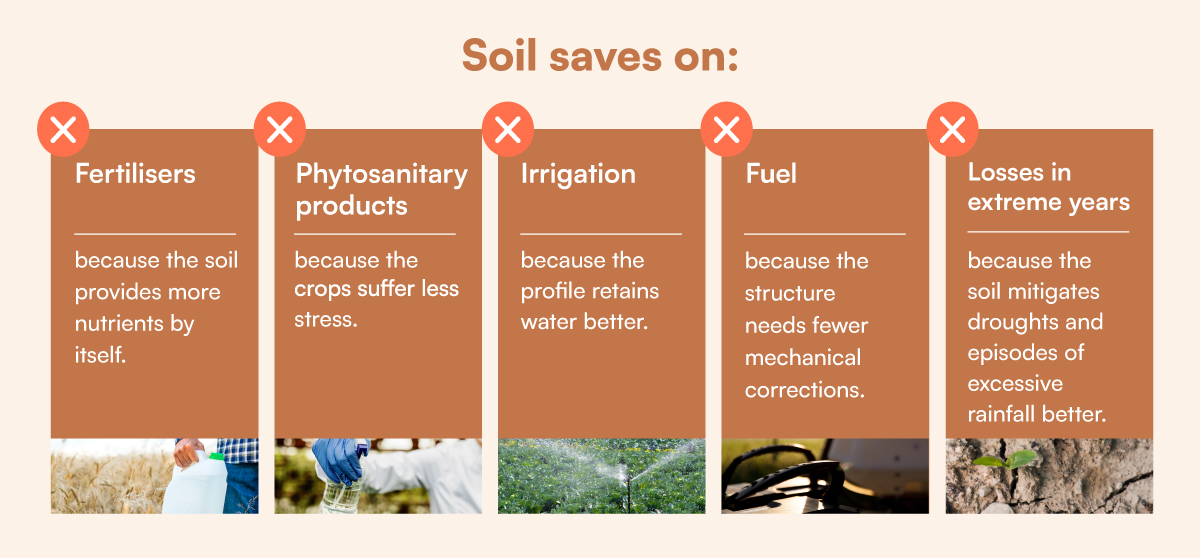
The report also explains the hidden balance that is yet to be effectively monetised – water, carbon, biodiversity and the revaluation of soil as an asset – but which is already beginning to influence markets, financing and traceability models.
If you’d like to understand why regenerating is not an organic luxury, but one of the few real levers to regain margin, stability and autonomy in European agriculture, we invite you to read the full report.
Read the full report here
Written by Fran Aparicio

Fran Aparicio coordinates Regenerative Agriculture at CrowdFarming, which mostly means he spends his days trying to make farmers, scientists and data people agree on what “healthy soil” actually means. He lives somewhere between muddy boots and research papers, translating field reality into something you can measure (and hopefully improve).
Comments
Keep digging ...