
Published October 2026
Statutes of 1% for the Soil
The rules governing 1% for the Soil
Anyone can join 1% for the Soil for free and closely follow the transition we finance. But before inviting you in, we believe you deserve to know how this works internally: where the money comes from, what it’s spent on, who decides, and what we consider a success.
These statutes are not a legal contract. They are the pact of a group of people who believe that European soil can and must regenerate, and that this regeneration depends on the decisions we make today. They define why the program exists, where the money comes from, what it’s spent on, how decisions are made, and what we understand by success.
I. Why We Exist
CrowdFarming’s mission: To make regenerative organic farming possible for farmers and accessible for consumers.
Soil is the planet’s most potential and undervalued resource, even though our subsistence depends on it. Decades of intensive farming have degraded 60% of European soil. More than 40 crops have lost up to 38% of their key nutrients since the 1950s. And the food system is responsible for over 30% of global greenhouse gas emissions, when it could be sequestering that carbon in the soil, making it more fertile and producing more nutritious food.
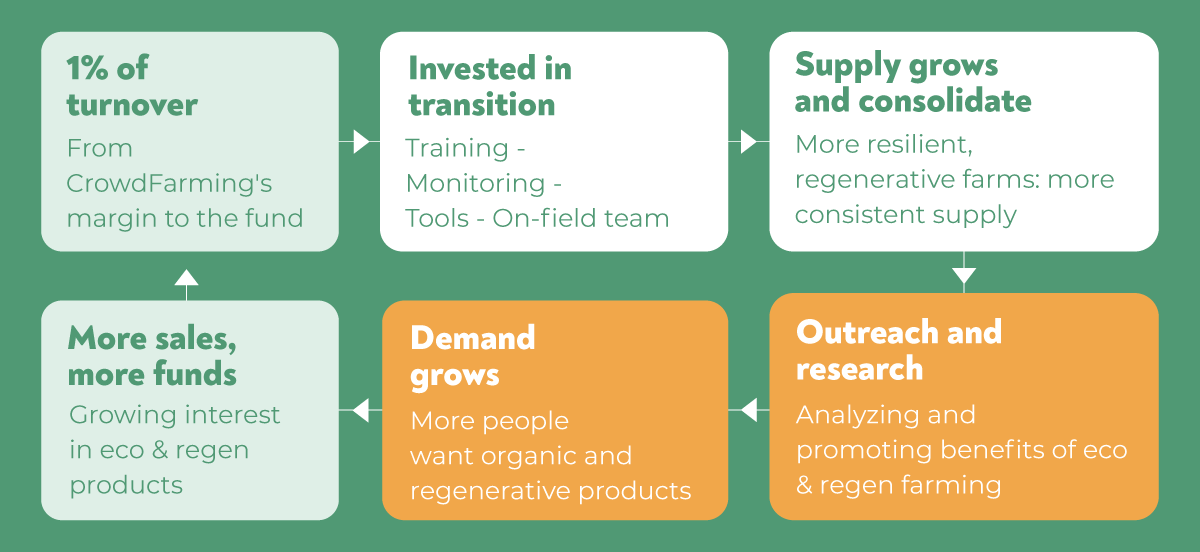
Given this, CrowdFarming decided in 2024 to allocate 1% of all gross revenue generated by its organic and regenerative farms to directly finance the transition.
The program focuses on growing the supply: ensuring there are more and more certified organic farmers regenerating their farm ecosystems, starting with the soil. This is the lever we act upon, because without sufficient supply, demand has nothing to sustain itself. It is also essential to grow demand, so that it is safer for the next farmer to take the step. The fund not only finances those starting the transition: it also supports those already producing regeneratively, because regeneration is not a goal, but a work of continuous improvement.
II. Where the Money Comes From
The fund is nourished by 1% of the gross revenue from CrowdFarming’s regenerative and converting-to-regenerative farms. Without raising prices. Without cutting farmers’ income. It comes from CrowdFarming’s margin, because we believe a resilient future is worth more than immediate profitability.
The 1% is a guaranteed minimum, not a ceiling. The fund is cumulative and can close a period with a surplus or deficit. In fact, CrowdFarming usually invests above that 1%: since its launch, 71% of what has been executed has come from the 1% for the Soil fund, and the remaining 29% has been complemented directly by CrowdFarming, exceeding its commitment.
The objective of this financing is not to subsidize the farmer or become recurring aid on which they depend to sustain their farm. The fund does not give money to the farmer: it finances on-farm results monitoring, training in regenerative techniques, and support to convert that data into decisions through management tools. It is the impetus that allows them to demonstrate that the model works and then sustain it themselves.
III. Who Is Part of It
Today, 1% for the Soil has a single type of member. Anyone can sign up, whether or not they are a CrowdFarming user. Being a member grants access to information about the program’s progress: funded projects, farms in transition, soil and nutrition results, and a full breakdown of how the fund is distributed, which we publish every six months.
Among members, we seek diversity of perspectives, not uniformity of values: from those who work within large agribusiness companies to those who have been criticizing them from outside for decades; from the agronomist with field data to the consumer who has been asking the right questions for years.
IV. How Initiatives Are Decided
The initiatives financed by the fund are decided through a jury and a fixed calendar, not discretionally.
The program operates in two semi-annual cycles per year, deliberately staggered with respect to the accounting close so that the jury votes with real budget figures on the table, not estimates. Proposals are submitted throughout the cycle following a common template: specific problem they solve, who implements them, geography and scale, itemized budget, 12-month success metrics, and potential conflicts of interest.
Before each decision, proposals that meet the minimum criteria are debated in the community space. This debate informs the jury’s assessment, which meets semi-annually and votes on what is funded. Each decision and its reasoning are recorded and shared with the community.
Today, the jury consists of three people: Juliette Simonin (CrowdFarming co-founder), Cristina Domecq (1% for the Soil director), and Yanniek Schoonhoven (farmer and founder of Regeneration Academy), who brings the perspective of someone in the field. Additionally, we will create an ad-hoc advisory committee to guide us from different perspectives and broaden our horizons.
V. What the Fund Invests In
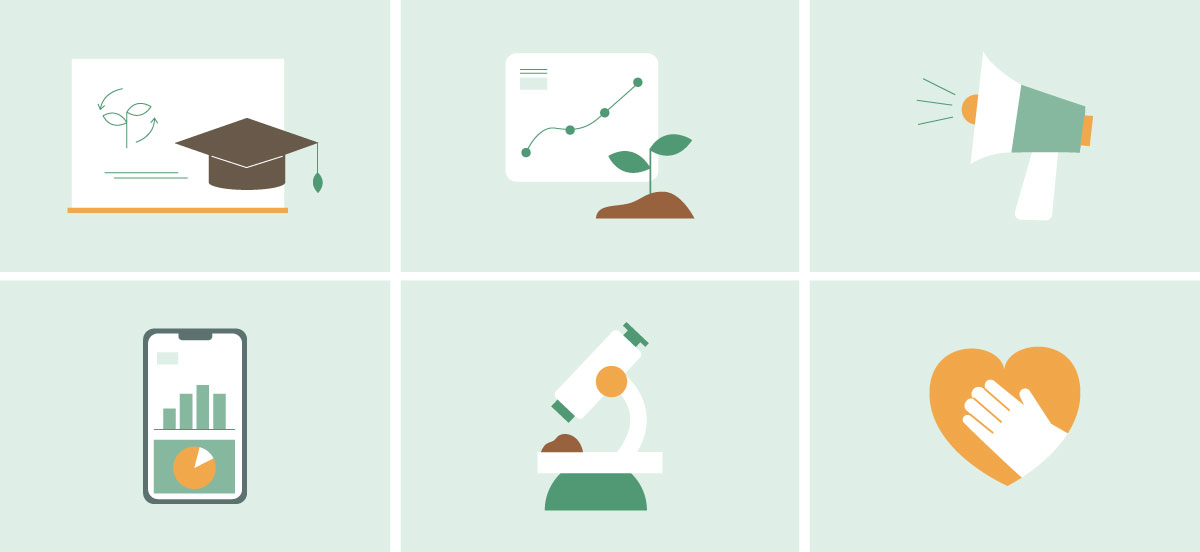
Resources are distributed across six categories:
- Training. Technical support, on-site and online: field events, continuous mentoring sessions, and connection between farmers with common goals.
- Monitoring. Measurement of on-farm results (soil, water, biodiversity, carbon, animal welfare, and social impact) to convert data into information for better decision-making.
- Dissemination. Promoting the model and its results so that demand grows at the pace of supply.
- Tools. Digital tools that optimize the farmer’s work and help them plan the transition, so they can focus on soil health and product quality instead of administrative tasks.
- Research. Scientific evidence to open institutional doors, validate the model, and transform collective thinking.
- Team. The people who execute the program on the ground: the agronomists who train and monitor, and the team that coordinates the fund and supports farmers. This is not an administrative cost: it is what makes everything else possible: the labor that converts fund money into training, measurements, and real on-farm follow-up.
How it has been distributed since its creation
Since its launch on July 1, 2024, we have invested €517,637 in the regenerative transition (including team dedication). We publish the full financial breakdown every six months.
| Category | % | Invested since 07/01/2024 |
| Training | 10% | €51,764 |
| Monitoring | 8% | €41,411 |
| Dissemination | 13% | €67,293 |
| Tools | 9% | €46,587 |
| Research | 0% | €0 |
| Team | 60% | €310,582 |
| Total | 100% | €517,637 |
Research does not yet appear as a direct fund expense in this period, but it is not an inactive line: we have dedicated team time to launch it, and in H1 2026 we will already have our first own data.
VI. What We Understand by Success
The success of 1% for the Soil is measured on two mutually supportive levels: impact in the field and community strength.
In the field, our first North Star was to transition 10,000 hectares of European land to regenerative systems. By the end of 2025, 4,176 hectares were in active transition and 53 farmers were in the official program, and as we approach that goal in mid-2026, we have decided to extend the commitment: to perpetuate the fund until 25,000 hectares are in regenerative transition.
In the community, success is bringing together and keeping active the largest European community that debates and decides on the future of regenerative agriculture, and ensuring that community truly participates in the fund’s decisions.
Goals per year:
| Year | Field | Community |
| 2024 | Fund launch (July) · first monitored farms | Community establishment |
| 2025 | 4,176 ha in transition · 53 farmers · €517,637 invested (cumulative) | 3,319 active members |
| 2026 | 100+ farmers and progress towards 10,000 ha (June) | 15,000 active members |
| 2030 | 25,000 ha in transition | 50,000 active members |
VII. Amendment of these Statutes
Any substantial change will be communicated to members at least 30 days in advance by email and/or agreed communication channels, such as the community space.
This is 1% for the Soil from the inside. If you’ve made it this far, you’re probably already one of the people European soil needs. Join 1% for the Soil.
Written by Cristina Domecq
Cristina Domecq is the Head of Impact at CrowdFarming. She operates where the boardroom, the field, and social conversations converge, convinced that the clues to fixing the food system are revealed in that intersection. Her goal is to achieve a behaviour change that sticks—a mission that only works if both farmers and consumers are truly on board.
Comments
Keep digging ...