
CrowdFarming's mission: to make regenerative organic farming possible for farmers and accessible to consumers.
Published October 2026
1% for the Soil statutes
Anyone can join the 1% for the Soil community for free and follow, up close, the transition we fund towards organic and regenerative farming. But before we invite you in, here’s how it works: where the money comes from, what it’s spent on, who decides and what we count as success.
These statutes are not a legal contract. They are CrowdFarming’s commitment to its mission and its community: a pact between people who believe Europe’s soil can and must be regenerated, and that this depends on the decisions we make today.
I. Why we exist
Soil is the planet’s most promising and most undervalued resource. And our survival depends on it.
Decades of intensive farming have degraded 60% of Europe's soils.
Over 40 crops have lost up to 38% of their key nutrients since the 1950s.
The food system accounts for more than 30% of global greenhouse gas emissions.
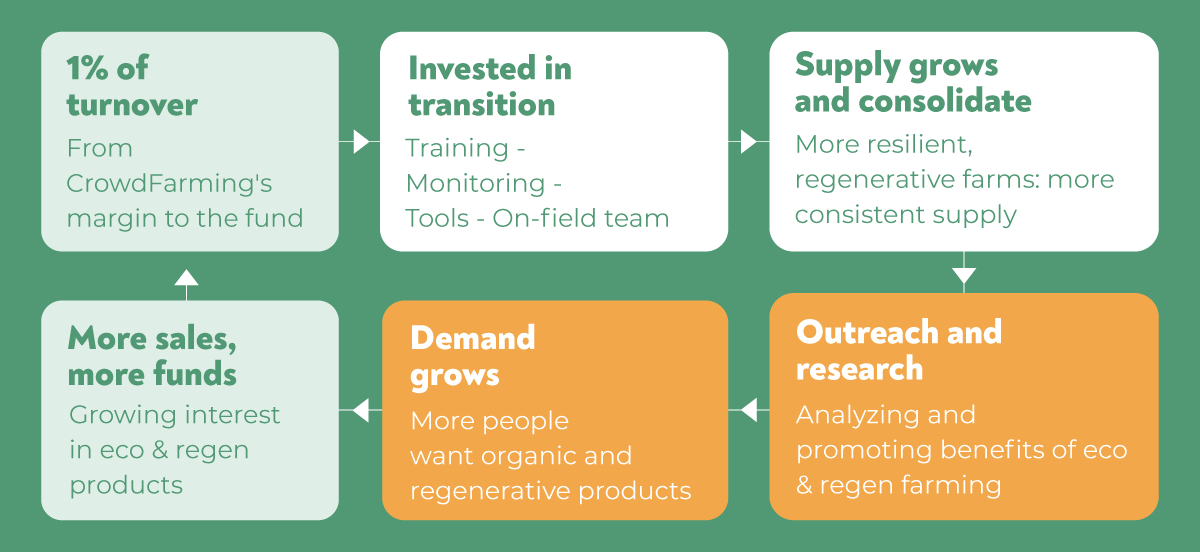
In 2024, CrowdFarming decided to put 1% of the gross turnover generated by its organic and regenerative farms directly towards funding the transition.
The programme focuses on growing both the supply of and the demand for organic and regenerative produce. A core part of 1% for the Soil’s work is getting more and more certified organic farmers to regenerate the ecosystems on their farms. But supply can’t survive without enough demand, so growing demand matters just as much: it makes it safer for the next farmer to take the leap and keep caring for their soil in the medium and long term.
II. Where the money comes from and where it goes
-
- The fund is fed by 1% of the gross revenue of CrowdFarming’s regenerative farms and farms converting to regenerative. No price rises. No cuts to farmers’ income. It comes out of CrowdFarming’s margin, because we believe a resilient future is worth more than short-term profit.
- The fund is cumulative and can end a period in surplus or in deficit.
- The 1% is a guaranteed floor, not a ceiling: in practice, CrowdFarming usually invests more, topping up the fund from its own margin when needed.
- This funding isn’t meant to subsidise farmers or to become a recurring payment they rely on to keep their farm going. The fund doesn’t hand money to farmers: it gives them the push they need to prove the model works, and then to keep it going on their own.
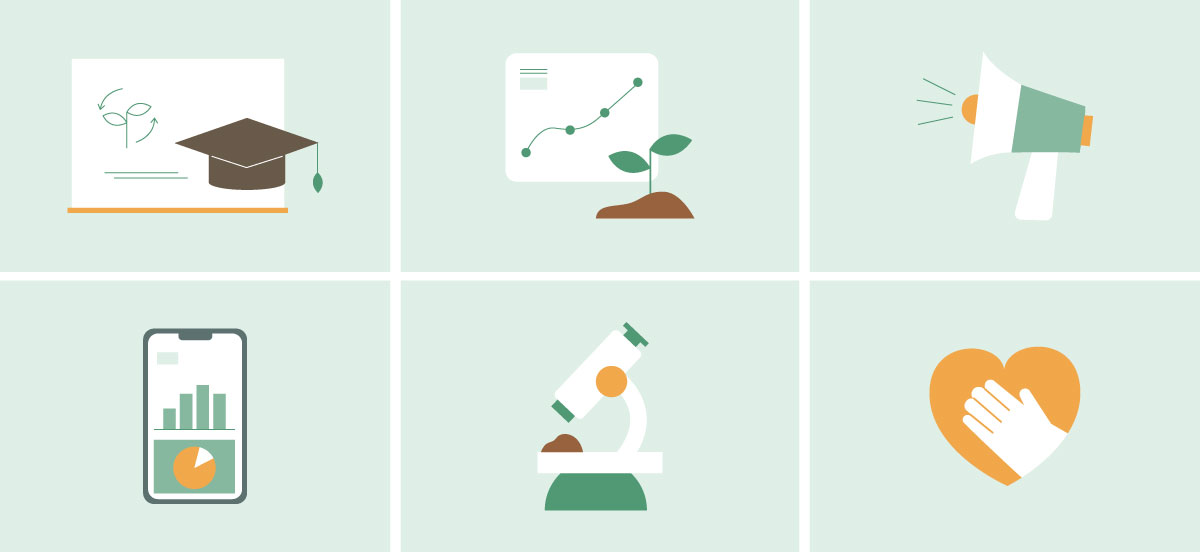
Resources are split across five categories
-
- Training. Technical support, in the field and online: field days, ongoing mentoring and connecting farmers who share the same goals.
- Monitoring. Measuring results on the farm (soil, water, biodiversity, carbon, animal welfare and social impact) to turn data into information for better decisions. This includes the time CrowdFarming’s agronomists spend on this work in the field.
- Awareness. Making the model and its results known so that demand grows in step with supply. This includes the time of the team behind this communication.
- Tools. Digital tools that streamline farmers’ work and help them plan the transition, so they can focus on soil health and product quality rather than admin.
- Research. Scientific evidence to open institutional doors, validate the model and shift collective thinking.
The cost of the people running the programme (agronomy, communication, fund coordination) isn’t recorded as a separate line: it’s allocated to the category they work in, because they are the ones who turn the fund’s money into training, measurements and real follow-up on the farm.
The full financial breakdown, period by period, is published every six months in the community report.
III. Who makes up the community
Today, 1% for the Soil has a single type of member, and joining is free. Anyone can sign up, whether or not they’re a CrowdFarming customer. Membership gives you access to updates on the programme’s progress: funded projects, farms in transition, news from the regenerative movement, soil and nutrition results, and the full breakdown of how the fund is spent, which we publish every six months.
We consult the community often, and for those consultations to mean something, we look for a diversity of perspectives, not uniform values: from people working inside big agrifood companies to those who have spent decades criticising them from outside; from the agronomist with field data to the consumer who has been asking the right questions for years.
The community lives on Circle, built as a space for conversation and debate, not a one-way monologue.
A few of the comments we received after the last six-monthly report:
“I'm completely convinced this is the way forward, and I'm so proud of you, your work and all these initiatives, even if all I do is eat this wonderful ‘food of the future’. It also gives me real hope to see more and more outside organisations noticing CrowdFarming and talking about it. Keep it up!”
“I feel honoured to be part of such a powerful community. Thank you for working so hard.”
“Thanks for this great update! Keep up the great work, we're with you.”
IV. How initiatives are decided
The programme runs in two six-month cycles a year, each in three phases:
-
- Closing and results (October and April). The accounting half-year closes and the results are shared in the Circle community: what has been invested, in what, and with what impact. Any member can ask for the details.
- Public consultation (November and May). A space opens up for ideas on what to fund next. Not every idea is adopted as it stands: some go into an ideas bank, some inspire tweaks to what we already do, and some are put into practice straight away. The whole community can comment on each other’s proposals.
- Preparation and implementation (December and June). The ideas that came up are prepared for the following half-year’s budget.
We’re also working on setting up an external advisory board to guide our decisions and ask us the right questions, in a consultative, non-binding role. Once again, we’re looking for a range of perspectives and leading voices from different fields:
-
- Agronomy and soil. Someone with hands-on knowledge of farming and of putting organic and regenerative practices into place.
- Food policy. Someone who understands how European agrifood policy works and knows how to navigate it.
- Regenerative finance. Experience financing the transition at scale.
- Research and nutrition. A university or institute researching the links between soil, nutrient density and health.
- Awareness and consumption. A voice that understands how results reach the people eating the food, and how they can change what they do.
- A critical outside view. Someone who has challenged the sector from the outside in order to change it.
We’re also exploring opening the fund to investment from other organisations aligned with our mission.
If any of this fits your profile or your organisation, write to us at impact@crowdfarming.com.
V. What we mean by success
The success of 1% for the Soil is measured on two levels that hold each other up: impact in the field and the strength of the community.
In the field
Our first goal was to transition 10,000 hectares of European soil to regenerative systems. As we got closer, we decided to raise the bar: to keep the fund going until 25,000 hectares are transitioning to regenerative.
In the community
Success means bringing together, and keeping active, Europe’s largest community debating and deciding on the future of regenerative farming, with that community taking a real part in the fund’s decisions.
Progress towards these goals, period by period, is published in the community’s six-monthly reports.
VI. Changes to these statutes
Any substantial change will be communicated to members at least 30 days in advance by email and/or other agreed channels, such as the community space.
This is 1% for the Soil from the inside. If you’ve read this far, you’re probably already one of the people Europe’s soil needs.
Become a member
Last updated: 28 October 2026
Written by Cristina Domecq
Cristina Domecq is the Head of Impact at CrowdFarming. She operates where the boardroom, the field, and social conversations converge, convinced that the clues to fixing the food system are revealed in that intersection. Her goal is to achieve a behaviour change that sticks—a mission that only works if both farmers and consumers are truly on board.
Comments
Keep digging ...